AI, Neurodiversity and Family | Jason A. Safford
Can AI Help Us Understand Each Other?
How a father and his two neurodivergent sons turned a birthday story into a published book, and what their journey asks of us.
By Jason A. Safford, Sr.
Humanity can make room for more kinds of minds if we choose to use AI's power to widen human expression and keep the people behind it in command.
The gift
For my father's ninetieth birthday, I asked my boys to make a story. Andrew and Austin would write and draw with me. I wanted to learn with them. I wanted to come closer. We shared our love for the man at the heart of the gift. That gave us somewhere to begin.
My father was reaching ninety. Andrew was eleven. Austin was eight. I stood between them as a son and a father. One part of me wanted to honor the man who raised me. Another wanted to know the boys I was raising.
Andrew presents with ASD, autism spectrum disorder. Austin is highly gifted and talented. I see those gifts in his mind, his feelings, and his body. I describe both boys as neurodivergent. Those words help me name parts of their lives. They leave much for me to learn.
The National Institute of Mental Health describes a wide range of autistic needs and strengths. [1] I keep that range in mind when I think about Andrew. A label cannot tell me what he means by a drawing. I need to make room for him to show me. His story deserves more than my quick reading of it. What might I miss if I decide too soon?
I face that question with Austin too. I can see his gifts and still miss his meaning. I can praise what he does while looking past what he wants. His strengths do not tell me what this book should ask of him. I wanted him to help make a gift. I did not want to turn that gift into a test.
Words and drawings gave us ways into the same gift. I did not have to ask the boys to explain themselves first. We could begin by making something together. Their ideas could take shape beside mine. The story gave us a reason to keep looking. Then the boys wanted to publish it.
That wish changed the work. We had set out to make a birthday gift. Now we had a book to finish. AI gave us a path toward that goal. I wanted to help the boys reach it. I also wanted their ideas to survive the trip.
What the picture keeps
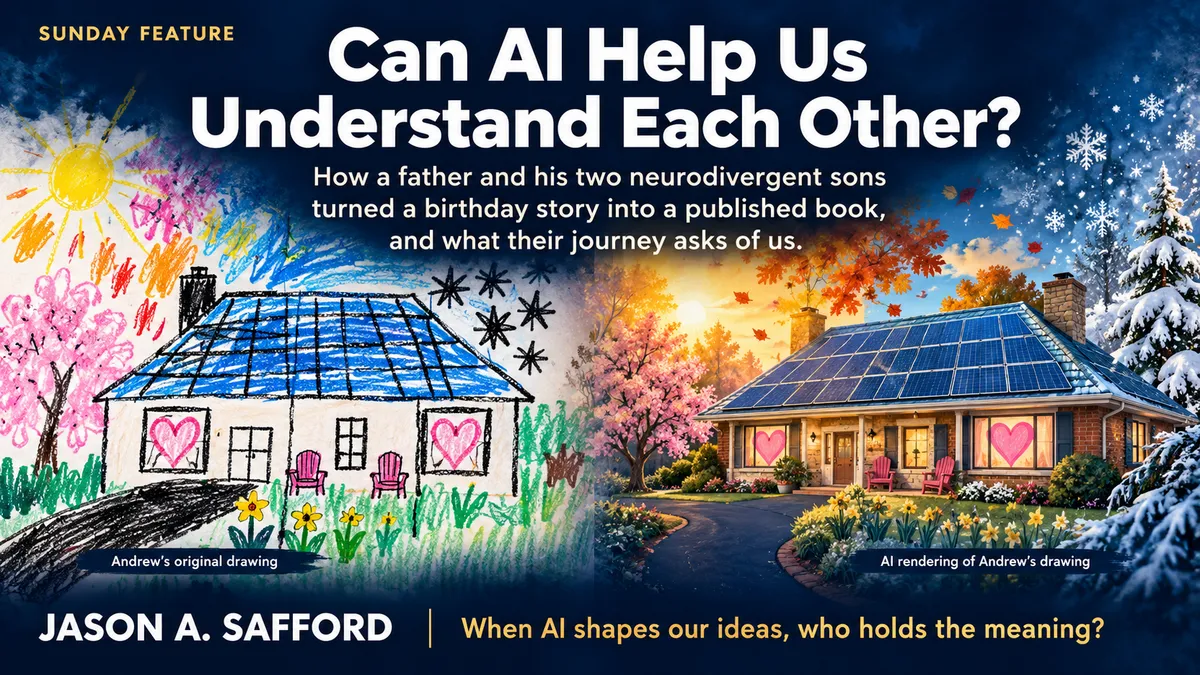
Andrew drew a family house for the project beneath a bright blue roof. Black lines divide the roof into grids. Two pink chairs stand near the windows. A dark drive curves up from the lower left. Yellow flowers rise beside the path. Above the house, color and marks fill different parts of the sky.
Look longer and the page gives you more. Red and orange strokes fall beneath the sun. Black star shapes gather on the right. Pink heart shapes sit within the house. Lines cross one another without hiding where they began. The color leaves white gaps in the paper.
The AI rendering turns Andrew’s house into a detailed book illustration. Rooftop grids become blue solar panels. The curved drive remains beneath the house. Large pink hearts fill the front windows. Flowers grow below them. Above the roof, leaves and snowflakes share a bright sky.
The hearts and seasons remain. Their form has changed. Black star shapes become white snowflakes, while colored strokes become falling leaves and blossoms. The rendering adds brickwork, shadows, and a snowy tree. My eye can move through a more detailed scene. The images let me examine how a machine gives form to another person’s marks.
I cannot learn a child's intent by counting what changed. Those hearts might matter in ways I have not yet understood. The marks in the sky might carry part of the story. A cleaner house might help someone see the drawing's structure. Only the people behind the work can help settle what belongs. I have to leave that question open long enough to hear them.
That comparison brings my conflict close. I wanted to help make something the boys could publish. AI offered a way to give their work a more finished form. But I could not judge that form by appearance alone. I had to consider what the changes might take with them. Did a clearer page still carry the idea we meant to share?
The original gives me something I cannot recover from the rendering alone. I can trace its crowded lines and see its choices. I can place it beside the new image. I can ask what remains and what has moved away. Keeping both makes room for a different kind of judgment. The version that looks finished need not become the only version worth seeing.
The word better
I kept coming back to the word better. Better for whom? The rendering gave Andrew's marks a form that might be easier for more readers to enter. I could see the promise in that reach. But accessibility could not settle the question of meaning. The original still had to remain part of the judgment.
Those doubts reached past the tool. I was the adult helping the book take shape. The wish to finish belonged to me too. I wanted to honor my father and help my sons. That gave my choices weight. It also gave my taste more power than I could afford to overlook.
The pleasure of making the book deserves its own place. The boys had asked for a real outcome. AI helped us reach toward it. Their ideas did not have to stop where our own skills stopped. I could take their wish seriously and help carry it further. I wanted them to have that chance.
No bad intent had to enter that space. A version I liked could begin to feel like the right one. I might see progress where a boy saw a change he did not want. That possibility asked more of me than skill with a tool. It asked me to leave room for a view beyond my own.
I began with a wish to connect. Publication gave me another goal to pursue. I did not want the second goal to swallow the first. We could make a book and still leave things unsaid between us. We could finish pages before I fully understood their meaning. Whose idea was I bringing to completion?
A place for your own story
Perhaps you have left a meeting unsure what someone expected. Perhaps you have read an instruction twice and still needed help. You may have known what you meant without finding the words. Those moments do not tell you what my sons experience. They may give you a place to begin listening. You know something of the distance between having a thought and getting it across.
Think of something you have wanted to make. A letter to someone you miss. A story your family might keep. A plan that has stayed unfinished for years. You may know its meaning more clearly than its form. What could change if help made that form easier to reach?
Now imagine asking for help with an important letter. The result sounds calm and clear. You can see why someone might prefer it. But one sentence carries a feeling you never meant. The error reaches someone you care about in your name. Your power rests in seeing that change and deciding what leaves the page.
A useful feature and a useful outcome ask different questions. A system might produce a summary of a recording. That does not establish that it improves someone's life over time. Checking could consume the time the tool promised to save. An error could assign someone a task they never accepted. The more important test begins after the output arrives.
The book gives our family one concrete outcome. It does not prove a treatment or a lasting gain in learning. I cannot use it to speak for every neurodivergent child. Another family might find the same tool tiring or unhelpful. What mattered here was the wish we brought to it. The larger promise needs evidence from lives beyond our own.
What the evidence can carry
A 2026 review maps AI research across neurodevelopmental conditions. It describes work in diagnosis, intervention, and ongoing support. Its authors note limited diverse pediatric data, privacy concerns, and bias. They frame AI as an aid within care led by people. [3] That promise reaches well beyond our book. So must the evidence supporting it.
In 2025, Bo Sun and colleagues reviewed 52 studies of AI and childhood ADHD. Twenty-eight used datasets smaller than 1,000 samples. Thirty-four tested models by dividing their datasets into parts. Those tests can reveal useful patterns within the data. The authors call for further testing across datasets. They describe a long path from research to clinical practice. [4]
That distinction matters when a high accuracy figure reaches a worried parent. A study may leave questions about a new clinic unanswered. The participants matter. So do the people the researchers left out. A result earns wider trust when testing reaches beyond its first dataset. Success at making our book cannot validate a diagnostic system.
The TRIPOD+AI guidance asks researchers to explain model development, evaluation, participants, and performance. [5] Those details give a parent grounds to question a claim. They expose what a reassuring number leaves out. A percentage cannot tell the whole story. Its limits belong beside its promise. A promise should survive that scrutiny before it shapes a child's care.
Imagine testing a model with equal numbers of two kinds of cases. Now use it where one kind occurs much less often. The same error rates can yield less trustworthy positive results. Mistakes may make up a larger share of them. The research number needs that context. [12] A family deserves to know what a prediction means in its actual setting.
The CDC says no single test diagnoses ADHD. Other conditions can produce similar symptoms. [6] Clinical judgment must remain part of that uncertainty. A confident answer cannot excuse a poorly matched test. An error could change a child's care. It could also shape how adults read that child for years.
Who gets to define help
A 2026 review examined 117 papers on inclusive human-AI interaction. The authors found that most lacked neurodivergent user participation. They also described gaps in long-term research and attention to differing sensory needs. Their call for co-design puts users inside the work of shaping support. [2] That finding brings me back to Andrew's drawing. Help begins to lose its purpose when its maker stops listening to its user.
I had chosen to bring AI into our project. I helped guide its use. The boys had asked to publish the story. That gave us a goal, but left choices along the way. I could not treat their first wish as agreement with every later change. I wanted their part in the project to remain real.
At home, that means more than asking whether a picture looks good. The boys need room to say whether it carries their idea. They need room to prefer the original. Their reasons need not match mine to deserve a hearing. Sometimes I still need to guide a choice. That responsibility belongs to me, and I cannot hand it to the tool.
UNESCO's guidance on generative AI in education calls for a human-centered approach. It urges protection of privacy and appropriate validation of educational uses. It also considers age when shaping access and design. [7] For a family, those aims need a practical test. A child needs another route when the tool does not help. An adult needs to check learning beyond the finished answer.
The same question reaches the workplace. Imagine receiving three shifting priorities with no clear order. An assistant could help arrange them into a plan. It could also arrange the wrong priorities with great confidence. Someone still needs to say what matters and what can wait. The employee should not bear every cost of an unclear handoff.
The manager has work to do in that handoff. Instructions can arrive in writing as well as speech. A meeting can end with agreed decisions and named owners. People can contribute before or after the live discussion. AI might help maintain those records. The choice to make the work clearer still belongs to the organization.
When help becomes a record
Imagine choosing a tool that helps you keep track of work. You decide what to share and can review the result. Now imagine an employer requiring that record to judge your attention. Their reading of you could affect your job. The difference sits in who holds the power. Support becomes harder to trust when refusal carries a cost.
I can picture my boys growing into schools and workplaces using such tools. I cannot know which ones they will choose. But I can name the freedom they should have. Andrew should be able to seek support without acquiring a hidden label. Austin should be able to ask for another format without proving his worth. Neither should have to trade privacy for the chance to take part.
NIST's AI Risk Management Framework links trust to several qualities. These include reliability, safety, transparency, privacy, and fairness. It treats the setting of use as part of the risk. Its approach is voluntary. [8] Those qualities give us grounds to question a service's claims. A familiar logo cannot supply the evidence.
NIST's generative AI profile also addresses confidently presented false content. It calls for checking sources and avoiding broad claims from narrow tests. [9] That speaks to the temptation I felt around a finished result. A convincing form can invite trust before we have earned it. I could admire an image and still examine what it changed. An institution could admire a score and still question what it measured.
An attention score demands an explanation from the system's owner. The owner needs to show what the tool actually observed. Evidence must link that observation to the claim. Testing must examine whether the score confuses different ways of working with lack of effort. The affected person needs a way to challenge the conclusion. Without those conditions, the score asks for authority it has not earned.
The risk could reach someone without a diagnosis. A pause might mean thinking. A quiet meeting might leave ideas waiting for a written reply. A person might need time before speaking. Scoring those moments as failure could reward the appearance of attention. Thoughtful work could lose ground to the performance of it.
For a neurodivergent person, that pressure could make support another demand to hide difference. Looking engaged in one approved way could become the price of access. The tool should help a person explain what works for them. Their account must matter in deciding whether the support helps. Calling a system inclusive cannot settle that judgment. My wish to help the boys asks the same restraint at home.
The things we share
Andrew's drawing can invite a conversation. He can tell me something I missed. The rendering might give us another way into that exchange. It cannot establish a diagnosis or reveal his feelings by itself. His account has a place no image can fill. I still need to listen.
UNICEF's guidance on AI and children calls for safety and protection of personal data. It also calls for fairness, inclusion, and accountability. The guidance recognizes possible gains in learning and disability access. [10] I want those opportunities for my boys. I also want to know what using a service asks us to surrender. A family project does not remove that duty.
Before sharing a sensitive detail, I need to know who can access it. Retention and training policies matter. So does what deletion removes. The answers must support a real choice. They help me decide what belongs in a prompt.
Parents have to make choices before children can understand every consequence. I feel that responsibility inside the wish to help. I can decide what goes into a prompt. I can also decide what never needs to go there. The boys' identities need not accompany every creative request. Sharing less can leave more of their lives in their own hands.
Power also means keeping another path open. The original drawing needs to stay within reach. A child should have room to use paper. A school should offer support without requiring a paid service. Access loses ground when one tool becomes the price of participation. Choice needs a usable alternative.
A fair trial of a tool measures more than output. It checks effort after review and correction. It examines whether someone can begin work with less confusion. The person using it helps judge the result. They can stop when the costs outweigh the help. Evidence then serves their choice instead of closing it down.
Back to Grandad
Our book is now published as The 5 Seasons of Grandad. AI helped us bring the project to completion. Andrew and Austin's wish became a book. I want to give that outcome its weight. We reached something we had not begun by planning to reach. A birthday story had found another life.
In the project's earlier editorial work, I asked for a different kind of patience too. A passage had focused on Grandad's slower movement and a cane. I asked to remove the cane reference. I wanted the grandchildren to accept what he could still do. Later, I asked to combine two versions about finding a shared pace. Those choices remain in the record of how we shaped the book. [11]
My father reaching ninety gave the gift a weight no software could supply. The boys brought their wish to create. I brought the wish to join them. AI helped us give that work a form. The reason for making it stayed within the family. The finished book needs to carry that reason with it.
My father reached ninety. His grandsons helped make a story for him. I had the chance to join those parts of our family. We brought the book into the world. I hope the boys can keep finding themselves in its pages. Can I keep seeing them when a machine offers me a more polished picture?
Sources and reporting notes
[1] National Institute of Mental Health. Autism Spectrum Disorder. Revised 2025. https://www.nimh.nih.gov/health/publications/autism-spectrum-disorder
[2] Xu Z, Liu F, Xia G, Duan Y, Yu L. 2026. A scoping review of inclusive and adaptive human-AI interaction design for neurodivergent users. Disability and Rehabilitation: Assistive Technology 21(4):943-961. https://doi.org/10.1080/17483107.2025.2579822. Author repository abstract verified at https://researchportal.hw.ac.uk/en/publications/a-scoping-review-of-inclusive-and-adaptive-humanai-interaction-de/
[3] Mohamed S et al. 2026. Applying artificial intelligence in neurodevelopmental disorders management and research. European Journal of Medical Research 31:185. https://doi.org/10.1186/s40001-025-03740-8. Abstract verified at https://pubmed.ncbi.nlm.nih.gov/41484902/
[4] Sun B, Cai F, Huang H, Li B, Wei B. 2025. Artificial intelligence for children with attention deficit/hyperactivity disorder: a scoping review. Experimental Biology and Medicine 250:10238. https://doi.org/10.3389/ebm.2025.10238
[5] Collins GS et al. 2024. TRIPOD+AI statement: updated guidance for reporting clinical prediction models that use regression or machine learning methods. BMJ 385:e078378. https://doi.org/10.1136/bmj-2023-078378. https://pubmed.ncbi.nlm.nih.gov/38626948/
[6] Centers for Disease Control and Prevention. Diagnosing ADHD. Reviewed July 30, 2026. https://www.cdc.gov/adhd/diagnosis/index.html
[7] Miao F, Holmes W. UNESCO. 2023. Guidance for generative AI in education and research. https://www.unesco.org/en/articles/guidance-generative-ai-education-and-research
[8] NIST. 2023. Artificial Intelligence Risk Management Framework AI RMF 1.0. https://doi.org/10.6028/NIST.AI.100-1
[9] Autio C et al. 2024. Artificial Intelligence Risk Management Framework: Generative Artificial Intelligence Profile. NIST AI 600-1. https://doi.org/10.6028/NIST.AI.600-1
[10] UNICEF Innocenti. December 2025. Guidance on AI and Children version 3.0. https://www.unicef.org/innocenti/reports/policy-guidance-ai-children
[11] Family project record. Pasted text(1).txt, saved August 4, 2026. Contains Jason Safford’s instructions to preserve the grandchildren’s artwork and revise the passage about Grandad’s pace. Draft dialogue and scenes in this record are literary material, not independently verified reporting.
[12] FDA. 2007. Statistical Guidance on Reporting Results from Studies Evaluating Diagnostic Tests. https://www.fda.gov/regulatory-information/search-fda-guidance-documents/statistical-guidance-reporting-results-studies-evaluating-diagnostic-tests-guidance-industry-and-fda. General principles of predictive value and prevalence; not an ADHD validation study.