Held by No One | Continuity in American Healthcare
Held by No One
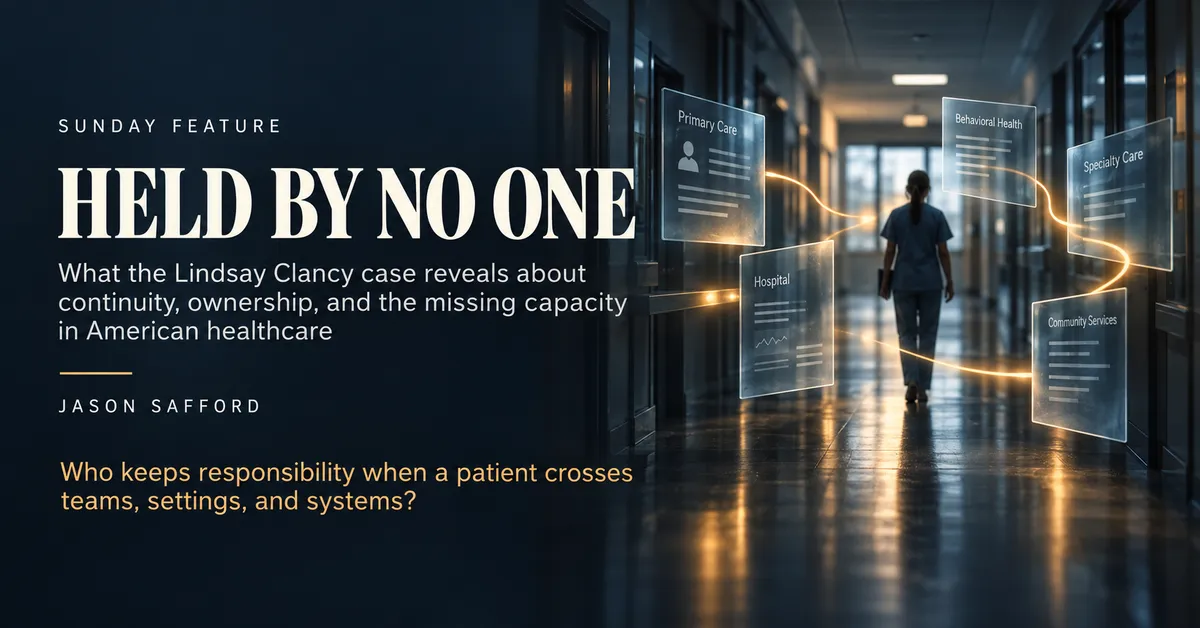
What the Lindsay Clancy case reveals about continuity, ownership, and the missing capacity in American healthcare
By Jason Safford
This account can see what no one inside Lindsay Clancy's care could see at the time: every visit, every note, and every hour gathered in one place after the fact.
No one built that view into her care while it still mattered.
Most care systems still lack it.
This story does not judge one woman. It asks who stood where they could see the whole of her care. The public record reviewed here names no one who held the whole path.
Content Note
This feature discusses the deaths of children, severe mental illness, and suicide. In the United States, call or text 988 for help during a crisis.
On a cold January evening in Duxbury, Massachusetts, Patrick Clancy left home to pick up medicine and food.
The trip looked like a small act of care. A bottle from CVS. Dinner from a nearby restaurant. The kind of errand families make without watching the clock.
Lindsay Clancy stayed home with their three children: five-year-old Cora, three-year-old Dawson, and eight-month-old Callan.
Nothing about the drive told Patrick that his life had reached its last ordinary minutes.
When he returned, the house had changed forever.
Years later, another room held the remains of that night. Jurors sat in a Plymouth courthouse with more than 300 exhibits. They heard from more than 80 witnesses. Doctors, relatives, police officers, and experts took the stand. The jury saw records, messages, searches, and notes. For five weeks, the court gathered the pieces.
Then twelve people tried to make them whole.
They could not.
After seven days, the jury remained divided. Court filings and juror accounts said eleven jurors favored a not guilty finding because Lindsay lacked criminal responsibility. One juror disagreed. On September 4, 2026, the judge declared a mistrial.
The criminal case still had no final answer.
Long before the jury met, Lindsay's care had produced its own stack of parts. Outpatient visits. Perinatal mental health contacts. An emergency evaluation. Day treatment. An inpatient stay. Discharge papers. Portal messages. Medication changes. Follow-up visits. Telehealth. Family observations.
Many people held a piece.
The public record reviewed for this story does not clearly identify one person who held the changing whole.
That absence does not prove that broken care caused the deaths of Cora, Dawson, and Callan. It does not show that another visit, another drug choice, or a care manager would have saved them. A medical record also cannot answer the legal question before the jury. Diagnosis and criminal responsibility require different judgments.
The story turns on one question of structure.
Across months of care, clinicians treated symptoms, reviewed risk, changed medications, managed transitions, and responded to Lindsay at certain moments. The public record does not clearly show one accountable person or team. No one appears to have held those moments across time, watched for a changing pattern, and made sure someone acted.
American healthcare has elaborate systems for delivering care.
It remains less clear about who must hold the whole.
The Distributed Record
A medical chart can create the look of unity.
Open the file, and a life seems to sit in one place. The screen may hold a drug list, visit notes, test results, diagnoses, and messages. Yet the neat frame can hide a basic fact. Each entry came from one point in time. Each writer saw the patient through the limits of one visit, one setting, one job, and often one computer system.
The chart gathers documents. It does not always gather meaning.
This does not mean clinicians fail to read closely or think with care. Many do, within the time they have. The system does not always give anyone the ongoing duty to hold the pattern across visits, shifts, and settings. Careful work in each visit cannot replace ownership across the whole path.
Lindsay's care crossed several settings and forms of contact. The public record describes rising distress, changing symptoms, medical opinions, family concern, risk reviews, and treatment changes. Some clinicians saw her before others. Some met her after a hospital stay. Each heard what Lindsay reported in that hour. Family members carried their own memories of what had changed at home.
Each piece could tell the truth.
The harder task called for someone to read the change between the pieces.
Did a new symptom mark a brief turn or a break from her usual state? Did poor sleep explain the change, or make it worse? Did a medication help, fail, or blur the picture? Did the person in one visit match the person in an earlier note? Did a family concern reach someone who could act? After discharge, who tracked the whole story from one day to the next?
Those questions ask more of a record than storage. They ask for synthesis.
Hospitals have made real gains in moving information. Federal data show that most nonfederal acute care hospitals can send, receive, find, and add outside health information to their records at least some of the time. Far fewer do all four as a routine part of care. Fax, mail, portals, and manual entry still sit beside newer systems.
Even perfect exchange would not solve the full problem.
Information can arrive without anyone owning what it means.
A lab result can move from one system to another. A discharge note can reach an inbox. A drug list can appear on a screen. But none of those events decides who must compare the new facts with the old. None decides who will call the family, reach the doctor, watch for change, and close the loop.
Technology can move the pieces.
Only a person or a named team can own the pattern.
The public record does not show which full records each clinician had during Lindsay's care. It does not show whether every system shared its notes, when outside records arrived, or who read them. It also does not name one person with clear authority after each change in care.
That missing proof should not invite invention. It should sharpen the question.
Who carried responsibility when the patient lived between the notes?
What Both Sides Now Allege
The public record gained a new layer in January 2026. Patrick Clancy and Lindsay Clancy each filed a civil lawsuit against the medical providers who treated her in the months before the killings.
Self-interest does not make an allegation false. It does not make it true either.
Each filing serves the person who brought it. Patrick's wrongful death suit seeks damages for himself and his children's estates. Lindsay filed a malpractice claim two days later through a lawyer who did not represent her at trial. Her criminal defense made much the same case. No judge or jury has tested either suit. Readers should treat both as allegations.
The details still matter. Patrick's complaint alleges that Lindsay received eight psychiatric medications in three weeks, from November 16 through December 5, 2022. The suit named four providers and health systems when filed. It has since grown to name eleven defendants. Lindsay's suit describes a web of providers. It alleges that they failed to diagnose the bipolar disorder that her lawyers say led to a psychotic break.
Husband and wife sued apart, yet raised the same concern about the structure of her care.
The lawsuits ask narrower questions than this story. Did a certain provider act with proper care? Did a drug decision fall below a professional standard? Does a named defendant bear legal blame for a specific harm? Those judgments belong in another room. They require a different standard of proof. Neither suit has reached judgment.
This story asks whether the system gave anyone a different duty. Did anyone need to see eight new medications in three weeks and ask what they meant together?
Courts test responsibility after harm occurs. They work one defendant at a time. The process moves slowly and often begins months or years after the fact. These lawsuits follow that design.
The harder question belongs to every health system that looks like the one described here. Who owns a patient's care after discharge but before the next visit? Who compares warning signs found in separate encounters? Who has the power to act before a lawyer must ask why no one did?
Courts may assign responsibility after a tragedy, one name at a time. Healthcare must establish ownership before one.
Contact Without Continuity
On a telehealth screen, a face floats inside a frame.
The provider may hear each word. The camera may show the eyes, the posture, and the set of the mouth. A remote visit can bring expert care into a home far from a clinic. It can shorten a wait. It can help a mother speak without finding a ride, arranging child care, or making another hard trip.
Telehealth can deliver good care. Research shows that remote mental health exams can work well, even for serious illness. An office visit can also miss a changing pattern when it stands alone. A remote team can create real continuity when it follows the same patient over time.
The central problem does not sit in the screen.
It lies in the frame.
Every visit has edges. The appointment begins. Questions follow. Symptoms become words. A clinician judges the facts at hand. The call ends. Another patient waits.
Outside the frame sits the rest of the day.
The dishes. The closed bedroom door. The half-finished meal. The hour of sleep no one can confirm. A spouse's unease. The small change that means little on Tuesday and something else by Friday.
Medicine often measures contact. It counts visits, messages, admissions, discharges, and response times. Those measures matter. Yet contact and continuity remain different things.
Continuity asks whether the same person or team knew the patient's normal state. Who gathered family concerns with consent? Who compared sleep, daily function, troubling thoughts, drug effects, and missed visits across time? Who could see old records? Who could raise the level of care? Who noticed when the patient did not improve?
Most of all, it asks who had to act.
That final question changes everything. A caring clinician may make a sound choice during one visit. A family member may report a troubling moment. A hospital may give clear directions at discharge. But if no one owns the next step, the system trusts that motion will become care. It assumes a referral will become a visit, a message will become a decision, and an instruction will create safety.
Sometimes they do.
But every handoff can open a gap.
Two Kinds of Capacity
Healthcare leaders face a genuine capacity crisis.
The country does not have enough mental health workers. Federal forecasts show a severe shortage of adult psychiatrists in the years ahead. By mid-2026, more than 157 million people lived in areas with federal mental health shortage designations. Beds remain scarce. Clinicians lose hours to paperwork. Emergency rooms hold people who need care elsewhere.
Under those conditions, speed matters.
Health systems improve flow. They shorten paperwork, expand telehealth, automate messages, improve schedules, speed discharge, and use artificial intelligence for routine work. These changes can create real capacity.
But they mostly create one kind of capacity.
Call this transaction capacity. It measures the power to complete more visits, messages, notes, referrals, and discharges.
Another kind matters just as much.
Synthesis capacity gives someone the time, records, power, and duty to understand what those separate acts mean together.
A system can increase the first while starving the second.
A system can schedule a mental health visit faster without naming who owns the days before it. It can send a discharge note at once without naming who must watch for decline. It can place years of records on one screen without asking anyone to resolve the conflicts inside them.
The problem reaches beyond moving information.
It asks whether responsibility moves with it.
Modern systems tend to fund what they can count. A visit has a code. A test has a result. A bed has a cost. A wait has a length. A discharge has a time.
Synthesis often hides between those units.
A clinician may read old notes before dawn. A nurse may call a spouse after work. One doctor may call another. A care manager may check whether a referral led to a visit. A team may pause and ask why today's patient does not match last week's record.
That work consumes capacity even when no dashboard shows it.
A resilient system does more than move work from one unit to the next. It keeps ownership of the whole as care crosses shifts, specialties, settings, and days.
Without ownership, speed cannot create resilience. It creates only motion.
The truth runs deeper. Complexity grows faster than people and systems can carry it. More data does not always lead to a better choice. More tools create more signals. More options create more handoffs. Our ability to understand those signals soon sets the limit.
Lindsay's care held many signals. The public record still leaves a basic role unclear.
Who carried them together?
What Families Cannot Carry
Family members often become the bridge.
They watch sleep. They hear a change in tone. They remember a drug's name. They drive to a visit and wait outside. They tell the story again because the old note did not arrive. They search a portal for the message that might explain what comes next.
Love makes them present.
It does not make them a clinical system.
Patrick Clancy and other relatives appear throughout the public account of Lindsay's decline and care. Their presence does not give them a duty to predict the unthinkable. A husband who runs an errand has not failed a safety plan because danger arose while he completed it. No system should ask a parent, sibling, or friend to join records, judge drug effects, assess danger, or command action across hospitals and medical offices.
Families can see things clinicians miss. Clinicians can read things families cannot. Neither can create continuity alone when the system leaves the role unnamed.
That gap becomes sharper after birth.
New parents often live inside broken time. Sleep comes in scraps. Bodies heal. Work begins again. Older children still need food, shoes, rides, and comfort. Relatives visit, then go home. Friends send food. A partner tries to cover the next hour.
Families may offer deep support and still leave gaps.
A mother may receive skilled care during a visit. Then she returns home, where no trained person watches what changes before the next one.
No family can provide constant clinical observation. No humane system should require it.
Do not ask why one person stepped away.
Ask why care depends so much on families filling gaps they should never have to close.
Building the Missing Role
Healthcare already knows how to build this function.
Collaborative Care offers one working model. A primary clinician works with a mental health care manager and a psychiatric expert. The team tracks a set group of patients. It measures change over time. It reviews people who do not improve. It follows up instead of waiting for the next crisis.
More than 90 trials and several large reviews have found Collaborative Care more effective than usual care for depression, anxiety, and other common conditions.
That does not prove the model would have prevented the deaths in Duxbury. The research does not support that claim. Most studies do not cover rare acts of violence, fast-changing mental illness after birth, or constant watch after discharge.
The model proves something smaller and more useful.
Systems can design ownership.
That marks the difference between an efficient system and a resilient one. A resilient system can still fail. But ownership survives the move from one setting, shift, or provider to the next.
A patient can have a named care manager. A team can keep a list of every patient it must track. A psychiatrist can review cases without waiting for each person to get a separate visit. A lack of progress can trigger action. Follow-up can become a duty instead of a hope.
Payment rules have begun to recognize the same need. In 2025, Medicare introduced Advanced Primary Care Management codes. The policy names a medical professional who remains responsible for primary care and serves as the main point for all needed health services. In 2026, Medicare added optional mental health and psychiatric Collaborative Care payments.
The words point to a duty.
A continuing focal point.
The codes do not solve the problem seen here. They work within set Medicare and primary care rules. They do not always reach a privately insured mother after birth. They do not create care around the clock. They do not ensure ownership through a severe mental health crisis after birth.
Still, the codes turn continuity into more than a good aim. A payer can name it. A system can staff it. A team can measure it. Someone can carry the duty.
The same question follows a mother home. Her most dangerous hours may unfold between visits, not inside a hospital or video call. A few states have begun to fund care in that space. Nebraska Medicaid now pays for nurse visits to mothers and babies younger than six months. The visits provide ongoing case management, not a single check-in. Arkansas Medicaid now pays trained community doulas for visits before and after birth. Neither program targets a mental health crisis. But each names a visitor, funds the visit, and treats the weeks after birth as a time that needs continued care.
Health systems rarely fold such visits into one clear clinical role. Families receive them as separate benefits based on their state or insurer.
True synthesis capacity needs more than a billing code. The owner needs records from every setting. The role needs a workable caseload, rules for family contact, clear power to act, and a way to track change between visits. Responsibility cannot vanish at discharge or stop at the edge of one medical group's software.
Most of all, the patient and family need a name.
Not a phone tree.
Not a portal.
A person or team that owns the whole path.
The Question for Healthcare Leaders
Every healthcare leader knows the pressure to move more patients through the system.
Leaders cut wait times, speed discharge, reduce paperwork, and expand access. Those gains matter. Yet speed can hide a deeper risk.
A system may move each part of care faster while losing the whole patient. Records can arrive. Visits can happen. Teams can complete each task. Still, no one may own what the pieces mean together.
This risk demands executive attention. Who sees change across time? Who joins clinical, operational, and family signals? Who can act when the pattern turns dangerous? Who keeps responsibility when the patient crosses systems?
Healthcare does not need one person to do everything. It needs an architecture that names ownership, preserves it across each handoff, and gives people the power to act.
Technology should help people see the whole sooner. It should not merely move the fragments faster.
The Room That Could Not Decide
Months of care produced a long record. The trial gathered much of that record into one room.
For five weeks, jurors heard different accounts of Lindsay's mental state. Experts, relatives, clinicians, and investigators took the stand. The jury reviewed more than 300 exhibits. The jurors faced a narrow, hard task. Did Lindsay bear criminal responsibility when she killed her children?
They did not agree.
That deadlock does not prove the healthcare system failed Lindsay or her family. It does not settle a diagnosis or name a missed step. It does not show that different care would have prevented the deaths. The mistrial left the charges unresolved.
Yet the courtroom offers one final image.
Long after the crisis, twelve people had weeks to study hundreds of exhibits. They heard experts and legal arguments. They also had hindsight as they tried to rebuild what happened.
The people living through it had none of those advantages.
Go back to the evening when it began. A husband left home for a prescription and dinner. No one would think to time that ordinary errand.
Visits, messages, prescriptions, discharges, family concerns, and days of worry filled the months before that night.
Healthcare moves each piece faster with every new tool.
The harder question asks who keeps responsibility when the pieces begin to mean something together.
An errand begins. A patient moves between home, portal, clinic, hospital, and screen. Notes gather. Each person does a part.
The stack grows.
Eventually, someone has to understand the whole.
American healthcare now moves information from one hand to another with growing skill.
Yet it spends less time deciding whose hand must not let go.
Case Status
The criminal case remained unresolved as of September 19, 2026. The mistrial neither acquitted nor convicted Lindsay Clancy. The court scheduled a September 29 hearing to address the case status, trial assignment, and the defense's renewed request for a required finding of not guilty. Defense counsel also raised a possible double jeopardy challenge.