The Adaptive Horizon: Leadership, AI, and the Human Capacity to Adapt
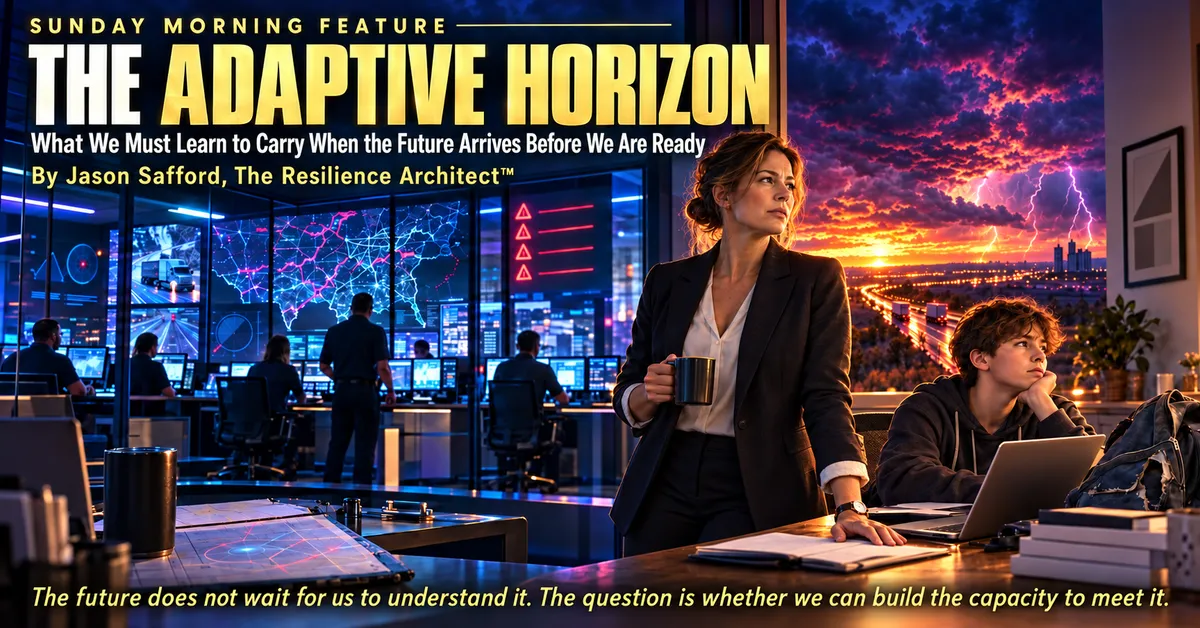
The Adaptive Horizon
What We Must Learn to Carry When the Future Arrives Before We Are Ready
By Jason Safford, The Resilience Architect
At 6:14 on Monday morning, before the sun cleared the houses, Elena Vance learned that her son's school might close from the heat, the rules governing her company's new technology were still trapped in debate, and eight people could lose their jobs before the week was over.
Her phone made each problem the same size.
A red dot held twenty-seven Slack messages. Below it sat a news alert about the stalled technology bill and an email from Leo's school, sent at 5:52 a.m. September had arrived, but the temperature was climbing toward one hundred. The district called its response a hybrid climate-adaptation schedule.
Elena read the phrase twice.
Behind her, the coffeemaker released a tired click. The kitchen window had begun to sweat at the corners. Her bare feet pressed against tile that no longer felt cool.
Upstairs, a drawer slammed.
"Mom, have you seen my charger?"
"Which one?"
"The school one."
That narrowed nothing.
Their house held a nest of black cords that seemed to breed in drawers and beneath furniture. Elena set the phone facedown and searched past batteries, takeout menus, two dead pens, and a thermometer. No charger.
The phone buzzed against the counter.
She left it there.
Another buzz came. Then another.
For a few seconds, Elena kept searching.
Need your final labor recommendation before eight.
Then another.
Board wants phase two moved up. Can the model absorb Great Lakes accounts by Friday?
Elena knew what "absorb" meant. Four dispatch desks. Twelve people. Years of knowing which warehouse manager answered before dawn, which bridge froze first, which driver should never be sent through Chicago at rush hour, no matter what the route software said.
By Friday, that knowledge was supposed to become a clean line on a cost report.
She found the charger under the couch, wrapped around one of Leo's shoes.
By 6:41, he stood at the counter in a gray hoodie, pulling at a loose thread near his wrist. Fourteen years old. Nearly six feet tall. Still young enough to leave milk on the counter, old enough to read every bad thing in the world before breakfast. His backpack sagged against the chair with a laptop, two paper books, a steel bottle, and one strap beginning to split near the seam.
"They might send us home early," he said.
"I saw."
"It's September."
Elena poured coffee into a travel mug. "Weather doesn't read calendars."
Leo did not smile.
"Are you coming Thursday?"
She stopped. Thursday was curriculum night. She had missed the spring conference and the high school welcome meeting before that.
"I put it on the calendar."
"That isn't what I asked."
Another message lit her phone. She turned it facedown.
"I'm going to try."
Leo lifted his backpack. The torn strap gave a small dry sound.
"Right," he said.
On the drive to school, the car thermometer showed eighty-one degrees. Cornfields beyond the highway had gone pale at the edges. A talk show host argued that machines were stealing work from honest people. Elena changed the station. Another voice praised artificial intelligence as the largest leap in human progress since the internet.
She turned that off too.
Leo watched a row of trucks move along the other side of the highway.
"Which side are you on?"
"Of what?"
"AI."
The light turned red. Elena looked at him, then at the road.
"I'm on the side that gets you to school before the bell."
His head leaned against the glass.
"That isn't an answer."
No, she thought. It was a habit.
For most of her life, Elena had survived by doing the next clear thing. When Leo's father left, she made a budget. When her mother got sick, she built a calendar for meals, medicine, and rides. When the logistics firm lost two major accounts in one winter, she rebuilt the routing process and stayed until midnight for six straight weeks.
Order was not just her skill. It was the shape she gave fear so she could carry it.
People called her steady.
Lately, steady felt like standing still on a floor that kept moving.
She parked beneath a thin maple tree at the far end of the company lot. At 7:12, her coach called. Elena placed the phone against the dashboard and opened the labor report on her laptop.
"I have fifteen minutes," she said.
"You have fifteen minutes before what?"
"Before I send the board my recommendation."
"You made it?"
"They want eight positions cut now and four more after phase two. Revenue is flat. Fuel and insurance are up. Our largest client wants another rate reduction, and a competitor is already running this software across three regions."
Silence came through the speakers.
Elena looked at the clock.
"Did you hear me?"
"I heard what the company needs."
"That is the problem."
"Part of it."
She closed her eyes. His pauses could feel like locked doors.
"Marcus Bell's position is on the list," she said.
"Who put it there?"
"I did."
Across the lot, Marcus stepped from an old sedan. He balanced his yellow legal pad on the roof while he searched for something inside the car.
"Why him?" the coach asked.
"The model can perform most of his routing work. He earns more than the other dispatchers. Removing the role saves another junior position."
"What does Marcus know that the model does not?"
Elena watched him find his Cubs mug and lift it from the passenger seat.
"A lot."
"Such as?"
She named the roads he avoided in lake snow. The yards where drivers could rest without losing their place in line. The managers who said yes on email and no at the dock. She described his habit of calling new drivers after difficult routes, just to make sure they reached home awake.
"Is that knowledge in the system?"
"Some of it will be."
"That wasn't my question."
Her hand tightened around the coffee cup.
"You don't have to present this to the board."
"No."
"You don't have to tell eight people they're done."
"No."
The answer angered her because it offered no fight.
"Then what are we doing?"
His voice stayed low.
"Trying to make sure the solution is not hiding part of the problem."
The dashboard clock changed to 7:27.
"The decision is due," Elena said.
"What are you afraid they will see if you ask for more time?"
She ended the call two minutes early.
At 7:38, the operations center smelled of warm plastic and burnt coffee. Maps glowed across the main wall. Thin blue lines moved from plants to warehouses, ports to rail yards, and rail yards to stores. Behind a glass door, the server rack gave off a low hum Elena could feel through the soles of her shoes.
Marcus raised his mug when she passed.
"Morning, boss."
Elena reached her office and opened the recommendation. His name waited on page three beside a projected annual saving.
She could request another week. The board might grant it. They might also decide she lacked the nerve to lead the change they had hired her to deliver.
For twelve years, Elena had built a career by being ready. Ready with the answer. Ready with the plan. Ready to carry whatever someone else dropped.
Admitting that the company did not yet understand its own work felt more dangerous than making the cut.
At 7:56, she pressed send.
At 8:07, six leaders filled the Monday call. Their faces sat in bright boxes across Elena's screen. The chief financial officer spoke from an airport lounge. The head of technology had blurred his bedroom behind him. A consultant used the phrase "human friction" three times in ten minutes.
Elena muted herself.
Human friction.
She wrote the words on her pad and drew a box around them.
Somewhere inside that box sat Marcus with his Cubs mug. Somewhere inside it sat the eight percent margin the board wanted back before year-end. Somewhere inside it sat Elena, who had reduced eighteen years of knowledge to a green number because green numbers did not ask whether she was afraid.
"Elena?" the CFO said.
She unmuted.
"I'm here."
"We have your recommendation. Can you begin notifications today?"
Across the room, Marcus laughed at something a driver had said. The sound came through the glass.
"Yes," she said. "I can begin."
At nine, he entered the conference room and closed the door with care. Elena had placed a box of tissues on the table. It looked false, like a prop put there by someone who had never watched another person lose a job.
Marcus did not sit.
"Just say it."
"Your position is being removed at the end of the month."
His jaw tightened.
"Removed."
"The new routing system will take over most daily dispatch decisions."
"Most."
"That is what we expect."
"We?"
Elena held his gaze.
"I recommended the position."
For the first time, he looked surprised.
Beyond the glass, a blue route shifted north, changed color, then vanished. Marcus lowered himself into the chair.
"Does it know Alvarez won't take frozen loads after Thursday because his backup unit is bad?"
"Maintenance records are being added."
"Does it know the dock at Benton floods when rain comes hard from the west?"
Elena said nothing.
"Does it know people lie when they're scared?"
The server rack hummed beyond the wall. From the main floor came the soft beat of keys and the ring of a phone no one picked up.
Marcus rubbed both hands over his face.
"You used to fight for us," he said.
The words landed without force.
That made them worse.
By lunch, everyone knew.
Nobody raised a voice. No one needed to.
Conversations stopped when Elena passed. Someone had taped a sheet of paper near the printer with a drawing of a robot wearing a crown.
Near the vending machines, Elena found Tasha Green staring at the staffing notice. Tasha worked nights and had been with the company eleven months. Her name was not on the first list. Phase two would be different.
"Do you know when the next cuts happen?" Tasha asked.
"No date has been set."
"My daughter has surgery in November."
Elena waited for a sentence that might help.
None came.
"I need to know about the insurance," Tasha said.
"I'll find out what I can."
Tasha nodded. She did not look relieved.
At 1:16, a friend sent Elena a post about the theft of human dignity by algorithms. Thousands of comments followed. Some called executives greedy. Others called workers afraid of progress. People who had never met Marcus or Tasha seemed certain they knew what courage required.
Elena closed the app.
Then she reopened the board dashboard.
Green arrows showed faster routes. Red numbers showed labor costs. A bright panel projected savings over twelve months.
Nothing on the screen had a place for Tasha's daughter, Marcus's late-night calls, or the silence near the printer.
At 3:04, Leo texted.
early release. bus late. its so hot in here
Elena called, but he did not answer.
A second text came.
im fine
Those two words had become the family flag for things that were not fine.
She reached home after seven. Leo sat at the dining table with both earbuds in and his laptop open. The air conditioner rattled in the window. On-screen, a blank document waited beneath the title What Should Humans Learn When Machines Can Think?
"How long have you been staring at that?" Elena asked.
"I wrote it already."
"Where is it?"
"Deleted it."
He pulled out one earbud. A bowl of cereal had gone soft beside him.
"The AI wrote a better one."
Elena set down her bag.
"Better how?"
"Better words. Better points. It had sources. It even sounded like me when I told it to."
Outside, cicadas screamed from the dark trees. A heat warning crawled across the bottom of the muted television.
Leo turned the laptop so she could see the empty page.
"Nolan used it for his essay. He got an A. Mrs. Carter said mine sounded like AI because the sentences were too clean."
"Did you use it?"
"Not for that one."
"Did you tell her?"
"She asked me to prove it."
Elena sat across from him.
"Could you?"
"How do you prove an idea came from you?"
His voice did not rise.
That frightened her more than anger would have.
"I don't know," she said.
Leo looked at the empty page.
"Then what am I supposed to learn?"
For a moment, Elena saw the same blank look Marcus had worn in the conference room. Not fear of a machine. Fear that the world had already made a choice about his value.
"What did your first essay say?" she asked.
"That learning is how you become someone."
"That sounds true."
"It sounds dumb."
"Maybe true things can sound dumb before we know how to say them."
Leo pushed the laptop away.
"Did you use AI to fire someone today?"
The question was so direct that Elena almost corrected the word use. She nearly explained budgets, the client, the competitor, and the board.
Each fact was true.
Together, they would have made a shield.
"A machine helped me decide his work cost too much," she said.
"Was it right?"
"I don't know."
"But you did it."
"Yes."
They sat with that.
No speech followed.
Elena warmed a plate of pasta and stood at the sink while Leo began his essay again, one slow line at a time.
Before bed, she opened the message thread with her coach.
I don't know whether I protected the company or hid behind it.
She watched the screen for an answer.
None came.
At 2:03 the next morning, her phone lit the room blue.
URGENT: ROUTING EXCEPTIONS ABOVE LIMIT
By 2:40, Elena was driving through a storm.
Rain struck the windshield so hard that the road appeared and vanished between each sweep of the wipers. New carrier rules had taken effect across one state line at midnight. Company lawyers had not agreed on which loads were covered. Farther west, floodwater had closed two roads the routing model still marked as open.
Inside the operations center, every screen held a warning. Routes looped back on themselves. Trucks carrying food, medicine, and machine parts idled across four states. Clients called faster than the staff could answer.
The system kept sending loads toward closed roads because its data showed they were clear.
"Shut it down," someone shouted.
"We can't," said the tech lead. "We'll lose the active routes."
"Then override it."
"The rules conflict."
Elena stood before the main map. Red lines spread across it like cracks in glass. Upper management wanted the software preserved. Dispatch wanted paper maps. Legal wanted no covered load to cross the state line until the rule was clear.
Every answer solved one danger by creating another.
Her chest began to tighten.
For years, pressure had made Elena faster.
That night it split her attention into pieces.
A driver was trapped south of Peoria. A hospital shipment needed cold storage. The CFO wanted a damage estimate. Leo had texted that the thunder woke him. On the wall, a timer counted the minutes each load sat still.
Elena pulled out her phone.
No reply waited from her coach.
For one sharp second, she felt abandoned.
Then the question from the parking lot returned.
What does Marcus know that the model does not?
She called him.
The phone rang six times.
"What?" Marcus answered.
"The new system is failing."
"I know."
"We have a hospital load blocked near Peoria. Flood routes are wrong. I need your help."
Rain rattled against the roof above her.
Marcus said nothing.
"I should have listened before," Elena said.
"Yes."
"I'm listening now."
Another pause.
"You fired me yesterday."
"I know."
"And now you want the part of me your system forgot to price."
Elena closed her eyes.
"Yes."
"I'm not coming back to save the company."
"I know."
"And I'm not handing over eighteen years for a thank-you and a cardboard box."
"Tell me what you need."
"Written transition work. Full pay. Six months of health coverage. Nobody else cut until the knowledge review is done."
Elena pictured the CFO's face when she presented the terms.
"I can approve the transition pay," she said. "The rest needs the board."
"Then get me your word that you'll take it to them."
The old Elena would have said she could not promise what she did not control.
"You have my word."
Marcus did not answer immediately.
Then he said, "Hospital load first."
He arrived twenty-eight minutes later.
His shirt was half buttoned beneath a raincoat. Water ran from the coat onto the floor. He set down his Cubs mug and looked at the red wall of routes.
"Where is it?"
For the next four hours, they worked side by side.
Marcus named roads that pooled in hard rain and yards with night crews who would answer a personal call. Elena sat with the tech lead and turned each detail into a rule the software could use. Dispatchers called drivers and heard what the data had missed.
Nobody defeated the machine.
Nobody trusted it alone.
At 5:26, the hospital load moved first.
A cheer rose, then died quickly. Too many routes still burned red.
Marcus leaned over Elena's keyboard and pointed at a shipment bound for Benton.
"That dock will flood by six."
"The model says seven-ten."
"The model isn't standing in that rain."
Elena changed the route.
Dawn came gray through the high windows. The storm thinned to a hiss on the roof. Coffee cooled in paper cups. People who had stopped speaking to Elena now stood close around one screen, offering bits of knowledge they had never thought to write down.
The software had not erased human judgment.
The company had failed to name it.
Years of touch, doubt, memory, trust, and small acts of care had been treated as waste because none of them fit inside a cell. The machine could move faster than any person in the room.
It could also carry a mistake farther than any of them could.
By seven, the worst had passed. No driver had been hurt. Most deliveries would arrive late. One client had already threatened to leave. The cost of the night would fill meetings for weeks.
Marcus stood at the sink, washing his Cubs mug.
"I was wrong," Elena said.
He kept his back to her.
"About what?"
"I thought the system was replacing a set of tasks. I didn't understand the work."
Marcus dried the mug with a brown paper towel.
"That doesn't give me my job back."
"No."
"You still cutting the team?"
Elena looked through the glass at the people bent over their desks.
"I'm stopping phase two until we map the knowledge, build an exception process, and agree on what requires human judgment."
"Can you do that?"
"I can refuse to sign it."
Marcus placed the mug in his bag.
"That's not the same as stopping it."
"No," Elena said. "It isn't."
At 8:30, the executive team appeared on-screen.
Elena presented the failed routes, the missing knowledge, and Marcus's terms. The CFO listened without moving. When she finished, he removed his glasses.
"The board approved this schedule," he said.
"The board approved savings based on an incomplete view of the work."
"Based on your recommendation."
"Yes."
The word stayed in the room.
"Are you refusing to lead phase two?"
Elena looked toward the operations floor.
Marcus was helping Tasha enter a night-shift rule into the system. The tech lead stood beside them, taking notes.
"I'm refusing to approve it under the current plan."
The CFO's face changed in a way Elena could not yet read.
"We will discuss your role after the incident review," he said.
The call ended.
Nothing in the room moved for several seconds.
At 5:18 that evening, Elena sat in the same far corner of the parking lot. Wet leaves clung to the windshield. Her coach called at the scheduled time.
"You didn't answer me," she said.
"You weren't asking for an answer."
"It felt like I was."
"I know."
She told him about the storm, Marcus's terms, and the board call. Speaking it aloud made the day sound both smaller and more dangerous.
"I listened," she said.
"What allowed you to listen?"
Elena watched two employees cross the lot. One held an umbrella over both of them.
"I stopped needing to be the person who already knew."
Her coach let the answer remain between them.
"They may remove me from the rollout," she said.
"They may."
"You could sound more concerned."
"Would that change what you saw?"
"No."
"Would keeping the role be worth pretending you did not see it?"
Elena leaned her head against the seat.
"I don't know."
"Good."
She almost laughed.
"Good?"
"For once, you are letting the question be larger than your first answer."
Silence settled inside the car.
Before they ended, he asked one more thing.
"What happens when listening costs more next time?"
Elena had no answer.
For once, she did not rush to create one.
At home, Leo had fallen asleep at the dining table. One cheek rested on his arm. The laptop glowed beside him, and his finished essay filled half a page.
Elena read only the last two lines.
A machine can help me say something. It cannot tell me if I mean it.
She closed the screen.
From the kitchen window, the neighborhood looked washed and strange. Broken leaves covered the road. Steam rose from the pavement as the heat returned.
Elena thought of the instructions that seemed to arrive faster every year.
Learn the new tool.
Watch the weather.
Check the alert.
Question the source.
Build a career.
Stay calm.
Keep up.
Each one made sense alone.
Together, they required a kind of strength no one seemed able to define.
For years, progress had meant more speed, more data, more reach, more ways to solve a problem before it had finished forming.
But every new power created another decision.
Every decision asked someone to carry the uncertainty.
The scarce thing was no longer the answer.
It was the human capacity to meet the answer without coming apart.
Elena lifted Leo's backpack from the floor.
The torn strap hung by several threads.
She found a needle in the junk drawer and sat beneath the kitchen light.
Her first stitch pulled the cloth too tight. The second missed the inner seam. Twice, the thread slipped free, and twice she began again.
Nothing told her whether the repair would hold.
In the morning, the board would demand another plan. Marcus would want more than Elena's word. Tasha would still need an answer about her insurance. Leo would return to a school trying to decide which thoughts belonged to children and which had been made for them.
None of it was solved.
Near midnight, Elena placed the repaired backpack beside her son's chair.
She pressed her thumb against the new seam.
Uneven.
Stronger than before, perhaps.
Not strong enough to trust without looking at it again.
On the counter, her phone began to glow.
She let it.