The Constant Compass: What Father's Day Was Really Invented to Remember
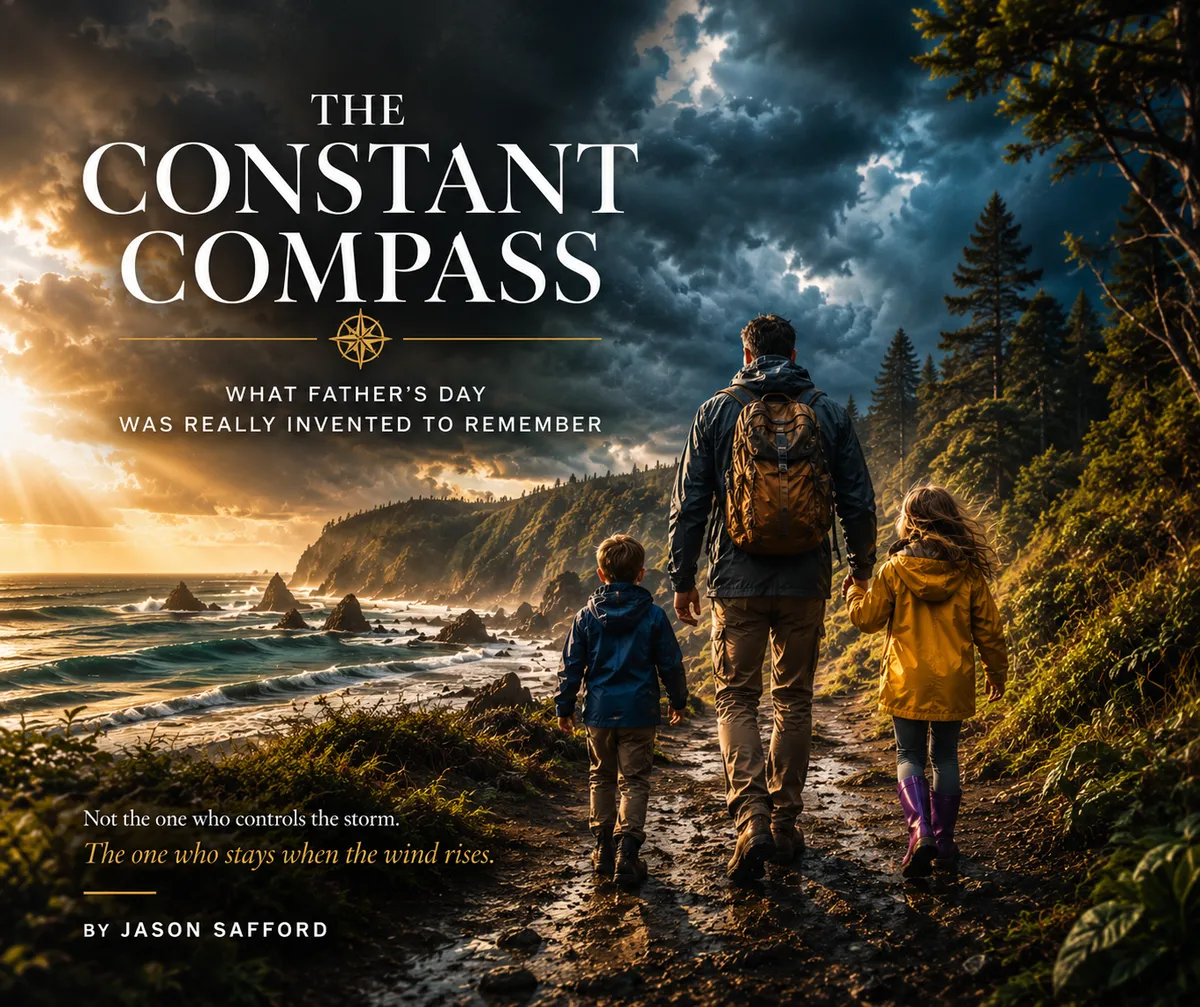
THE CONSTANT COMPASS
What Father's Day Was Really Invented to Remember
By Jason Safford
A brisk wind bent the maple branches outside Daniel's bedroom and sent the loose gutter above the garage into its familiar rattle. Storm warnings covered the evening forecast, though dawn still held that strange peace that often arrives before weather changes its mind. His phone glowed beside a half-read novel and the reading glasses he forgot to put away the night before. News alerts marched across the screen before his feet touched the floor. Missiles. Artificial intelligence lawsuits. Another story about loneliness. Another study about children and screens.
Coffee hissed through the machine while the rest of the house slept. Daniel stood at the kitchen sink and watched leaves turn silver beneath the wind. Every headline seemed to carry the same message in different words. Nobody knew what came next. Another alert flashed across the screen before he silenced the phone and slid it facedown on the counter. Soft footsteps crossed the hallway.
Emma appeared in pink pajamas with her stuffed rabbit tucked beneath one arm.
"Is the storm coming?" she asked.
Daniel poured milk into her cereal bowl and glanced toward the dark clouds gathering beyond the trees.
"Later."
She seemed satisfied.
Children rarely ask the question they mean to ask.
The calendar on the refrigerator still showed June. A Father's Day card waited beneath a magnet beside soccer schedules and grocery lists. Somebody at school had helped Emma write his name in purple marker. Construction paper. Crooked letters. Glitter everywhere. Looking at it, Daniel realized he had never asked why Father's Day existed in the first place.
Most people treated the holiday like an excuse for barbecue grills and neckties. Store aisles overflowed with coffee mugs and funny cards. Commercials promised perfect families that looked nothing like real life. Yet somewhere along the way, somebody decided fathers deserved remembering. Not because they succeeded every time. Not because they always stayed. Simply because enough of them did.
Back in 1910, a woman named Sonora Smart Dodd sat inside a Spokane church and thought about her father. William Smart had returned from war and raised six children after losing his wife. Nobody called him extraordinary. No crowds gathered around his fields. Life expected him to continue, and he did. Father's Day began because one daughter believed ordinary devotion deserved a place on the calendar.
History rarely pauses for ordinary things. Nations celebrate victories and mourn disasters. Families remember something smaller. A bicycle repaired after dinner. Tire pressure checked before vacation. Strong arms carrying a sleeping child from the car after a long drive. Civilization survives through moments too quiet for monuments.
A handmade Father's Day card still hung beneath a magnet on the refrigerator beside grocery lists and soccer schedules. Purple marker bled through the paper where Emma had written his name in crooked letters. Glitter covered one corner. Daniel smiled when he looked at it and then realized something that surprised him. He had never asked why Father's Day existed at all. Like most people, he had accepted neckties, barbecue grills, and funny cards without wondering who decided fathers should have a day of their own.
Curiosity followed him through the morning. A quick search led him back to Spokane in 1910 and to a woman named Sonora Smart Dodd. Sitting in church one Sunday, she thought about her father, William Smart, a Civil War veteran who raised six children after his wife died. Nobody called him remarkable. No statues carried his name. He farmed, worked, and kept going because six young lives depended on him. Father's Day began because one daughter believed ordinary devotion deserved remembering.
History rarely pauses for ordinary things. Nations celebrate victories and mourn disasters. Families remember something smaller. A bicycle repaired after dinner. Tire pressure checked before vacation. A sleeping child carried inside after a long drive. Civilization itself rests upon moments too quiet for monuments.
Photographs lined the hallway outside Daniel's bedroom. Farmers stared from faded frames. Soldiers stood beside trucks and ships. One grandfather sold insurance for forty years. Another worked with his hands until arthritis twisted his fingers. None became famous. Each lived inside different storms. All spent their lives trying to become what somebody else needed.
By afternoon, Daniel sat beside the soccer field watching parents scroll through glowing screens while children chased loose balls beneath gray skies. Conversations drifted through folding chairs and coffee cups. Somebody joked about divorce. Another father complained about a podcast his teenage son had discovered. A mother laughed about men needing to "find themselves." Nobody sounded angry. Most sounded tired. Beneath the jokes and opinions sat something harder to name.
Old disappointments traveled beneath new language. Some people carried scars they never discussed. Others fought loneliness behind busy calendars and smiling photographs. Quiet doubts followed marriages into silence and waited beside empty beds. Nobody really wanted power over another person. Most simply wanted somebody they could trust when life became heavy.
Children entered none of those arguments.
A son waiting beside the fence cared little about ideologies. A daughter climbing into bed after a nightmare never asked about movements or manifestos. Small voices carried simpler concerns.
Will Dad come?
Are Mom and Dad okay?
Am I safe?
Those questions survived wars, recessions, protests, and every cultural revolution because children seek something older than agreement. Long before they understand politics, they search faces for reassurance. Presence matters more than perfection.
And perhaps presence has always been the first language of love.
Photographs in the hallway told one story. Life outside told another.
Daniel's grandfather spent forty years worrying about layoffs and rising gas prices. His father watched interest rates and recessions. Men from earlier generations measured danger in factories, wars, and unpaid bills. Love often wore a quiet face. Many carried fear the way they carried wallets and keys. They believed protection meant keeping worries to themselves.
The world handed Daniel a different map. Screens glowed in every room. Phones erased the old borders between work and home. News arrived faster than anyone could understand it. Arguments traveled at the speed of light. Children inherited a universe larger than their parents had ever imagined. Somewhere along the way, fathers became navigators of emotional weather as much as economic weather.
Saturday mornings belonged to soccer. Folding chairs lined the field while coffee cups balanced beside coolers and gym bags. Parents cheered, laughed, and scrolled through glowing screens between plays. Half the crowd missed a goal because everyone checked messages at the same time. Applause followed a few seconds later. Embarrassed smiles spread through the bleachers.
Daniel slipped his own phone into his pocket and watched his son race toward midfield. Wind bent the trees behind the goalposts. Clouds gathered farther west. Somewhere nearby, two fathers joked about their teenage daughters growing up too fast. A mother laughed about podcasts her son had discovered. Another parent worried about social media and shrugged.
Nobody sounded angry.
Most sounded tired.
The feeling stayed with him long after the game ended. His grandfather worried about keeping food on the table. His father worried about keeping a job. Daniel worried about keeping his children present in a world designed to scatter their attention. Different storms arrived with every generation. Different fears changed their names.
Yet the assignment never changed.
Help children make sense of the world.
Not control it.
Not explain every mystery.
Not remove every hardship.
Just stand beside them long enough to teach them how to walk through it.
Across the field, his son waved after practice ended. Daniel waved back and noticed Emma sitting beside his wife, hugging the stuffed rabbit she carried everywhere. She smiled when she saw him. Then she looked toward the dark clouds gathering above the trees.
"Daddy," she asked quietly, "are storms scary?"
Daniel smiled.
"Sometimes."
Emma studied his face for a moment.
Then she asked the question she really wanted answered.
"Are you always going to be here?"
Dark clouds finally caught the house after sunset. Wind shook the maples harder now and sent branches scraping against the siding. Somewhere in the distance, thunder rolled low across the sky. Daniel sat in the living room with a book open in his lap, though he had read the same page three times without remembering a word. Emma's question from the soccer field still lingered in his mind.
"Daddy, are you always going to be here?"
A small voice interrupted the silence.
"Dad?"
Emma stood in the doorway holding her rabbit against her chest. Her hair still smelled faintly of shampoo. Lightning flashed beyond the curtains and painted silver lines across the hallway. Without waiting for permission, she stepped closer and climbed onto the couch beside him. Daniel lowered the blanket across her legs while she settled against his shoulder.
"Storms are loud," she whispered.
"They are."
Another rumble passed overhead.
Emma stayed quiet for a moment.
Then she asked the question children have asked since the beginning of time.
"You're not going anywhere, right?"
The room grew still.
Daniel looked toward the dark windows. Wind bent the trees. Rain tapped softly against the glass. His daughter waited beside him, trusting that fathers knew things they often didn't know at all.
Children believe promises adults cannot always make.
A thousand answers passed through his mind. Life had taught him too much to speak with certainty. Men lost jobs. Marriages broke. Bodies failed. Accidents happened. Good people disappeared before anyone was ready.
Yet children ask simple questions because they trust simple answers.
What they really mean is something else.
Will somebody stay?
Will I face hard things alone?
Will somebody answer when I call?
Emma rested her head against his chest while thunder drifted farther east. Daniel wrapped his arm around her and closed the book. Somewhere inside that moment, another memory began to surface.
He was nine years old again.
The year was 1983.
And he was asking his own father whether the world was coming to an end.
Long ago, another storm filled another sky.
Daniel was nine when television screens warned about nuclear war. Adults lowered their voices when children entered the room. One night he found his father sitting alone in the den and asked the question that had haunted him all week.
"Can bombs hit us here?"
His father muted the television and sat quietly.
"Bad things happen sometimes," he said.
Then he waited.
"But people help each other."
Forty years later, Daniel understood what his father had really given him.
Not certainty.
Direction.
The old man had not explained the world. He had simply refused to let his son face it alone.
Thunder drifted east while Emma slept against his shoulder. Daniel carried her to bed and paused in the dark hallway. Photographs covered one wall. Farmers. Soldiers. Mechanics. Salesmen. Ordinary men carrying ordinary lives. Different beliefs. Different fears. None controlled the storms that found them. Still they woke. Still they answered when somebody called.
Outside, the same brisk wind that greeted the morning moved through the maple branches. By dawn, headlines would return. Markets would rise and fall. New wars would replace old ones. Storms would gather. Children would keep asking the same questions they have always asked.
Will Dad come?
Are Mom and Dad okay?
Am I safe?
Civilizations change.
Children don't.
Near the end of his life, Daniel's father forgot names and dates. Memory slowly abandoned him. Yet one afternoon, he reached for Daniel's hand and smiled.
"I know you."
Then he whispered the last words Daniel would ever hear him speak.
"I'm here."
Standing alone in the hallway, Daniel thought about the woman in Spokane who believed quiet devotion deserved remembering. Not because fathers were perfect. Not because every story ended well. Because civilization itself depends upon people who answer when they are called.
Storms have always existed.
Wars existed.
Loss existed.
What frightens us most is something deeper.
The thought of calling into the darkness and hearing nothing answer back.
Perhaps that is why Father's Day exists.
Not to celebrate, settle, or pretend what exists.
The day exists because children understand something adults often forget.
Everyone needs a compass.
Before sunrise, millions of fathers will wake quietly. Coffee will hiss through waiting machines. Ordinary men will begin ordinary days.
And somewhere nearby, a small voice will break the silence.
"Dad?"
If grace allows, a tired voice will answer.
"Yeah?"
Perhaps that exchange, repeated across centuries and continents, has always been the meaning of Father's Day.
A child calling into the darkness.
And hearing a voice answer back.
"I'm here."