The Forecast Was Right | AI, Resilience & Leadership
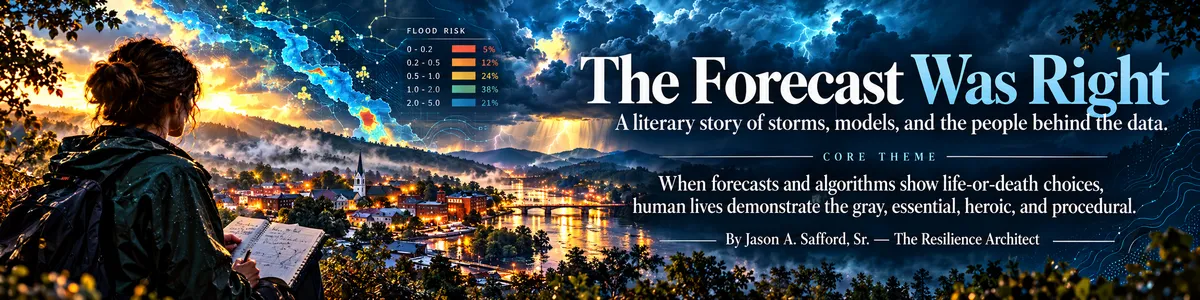
The Forecast Was Right
What will we owe one another when we can no longer claim we did not know?
by Jason A. Safford, Sr. | The Resilience Architect
Literary note: This narrative uses fictional characters, dialogue, companies, and events.
Research source: United Nations Environment Programme, Adaptation Gap Report 2025.
The River
Floodwater crossed the kitchen threshold before Elena heard her son scream. It spread across the tiles, carrying leaves and grit beneath the table. Daniel stood on the stairs with one blue sneaker on his foot. He held the other by its laces. Rain beat against the windows, and the ceiling light blinked twice. Then someone began pounding on the front door.
Three days earlier, Elena's phone had warned her about the coming flood. She read the notice during a shift at the grocery store. Customers bought batteries, bottled water, and bread without looking at prices. Her manager needed her through the weekend because two workers had called out. Elena needed the wages more than she feared another storm. The river had risen before, but it had never reached her kitchen.
She had paid the rent that morning. Eighty-three dollars remained in her checking account. Her car needed a repair that cost more than two weeks of wages. The county shelter lay across the bridge, where rising water often closed the road. The last bus left town before the heaviest rain arrived. Elena understood the warning and could not find a dependable way to leave.
The pounding grew louder. Mrs. Reyes stood outside, bracing herself against the porch rail. Water moved around her knees, and rain ran from her gray hair. Across the street, her husband struggled to rise from a chair beside their window. Their daughter had tried to reach them, but the flooded road turned her back. Mrs. Reyes held out a shaking hand and asked Elena for help.
Daniel pulled his mother toward the stairs. Elena knew a narrow path behind the houses that climbed to higher ground. She had walked it as a girl and trusted its steep bank. She could take her son there now, before the current grew stronger. The older couple would never manage the climb without another pair of hands. She looked from Daniel to the woman on the porch.
"Come with me," Daniel whispered. Elena knelt and slid the second sneaker onto his foot. She told him to wait on the landing while she helped their neighbors. He caught her wrist and asked her not to go. Elena promised she would return in a moment. His face changed before she finished the promise.
Elena crossed the street with Mrs. Reyes and entered the dark house. Mr. Reyes gripped his cane but could not straighten his knees. She took his left arm while his wife supported his right. They moved across the wet floor as water pushed through the doorway. Outside, Daniel called for his mother above the rain. Elena tightened her hold and urged the old man forward.
They reached Elena's porch as another surge swept along the road. She found Daniel on the landing, just where she had left him. He wrapped both arms around her waist and refused to let go. Elena lifted his schoolbag, wrapped his medicine in plastic, and found the back door. Mrs. Reyes carried a small bag of prescriptions. Together they started along the rising path behind the houses.
Halfway uphill, Mr. Reyes slipped on a root. Elena caught his arm and lost her own footing. Daniel reached for her as water rushed across the narrow trail. One blue sneaker tore loose and spun downhill. He bent after it, and Elena pulled him upright by his coat. She let the shoe go and kept both hands on the living.
They reached the neighbor's porch before floodwater covered the lowest stones. Someone opened the door and drew them into a dry room. A woman brought blankets while another called the emergency number. Elena counted the four people she had brought uphill. Across the street, water climbed past the windows of her kitchen. Daniel sat against the wall and held his one surviving sneaker.
He refused the hot tea a neighbor offered. Elena sat beside him and tried to warm his hands. He asked why she had left him on the stairs. She told him that Mr. and Mrs. Reyes needed help. He stared at the lone shoe in his lap for a long time. Then he looked at her and asked, "What if you didn't come back?"
The Price of Knowing
The rain stopped, and floodwater left a brown line across Elena's kitchen wall. Mud filled the cupboards and settled inside the refrigerator. The grocery store closed for repairs, and Elena lost another week of wages. Daniel's school moved classes to a building across town. The bus route still crossed damaged pavement near the bridge. Each morning brought another bill and another office to call.
The town already knew about the weak equipment at its stormwater pump station. Rain normally drained through pipes toward the river. When the river rose above those pipes, floodgates stopped water from flowing backward into the streets. Electric pumps then had to lift the trapped rainwater into the higher river. A faulty backup switch kept one pump from starting when the main unit struggled. Water gathered in the low basin and entered the houses nearest the ditch.
The town's maintenance staff had requested a new switch before the storm. They had also reported trouble at the low road beside the bridge. A forecasting service had warned officials about the rain. Each warning had crossed a desk, entered a queue, and waited for money or workers. By the time the storm arrived, the part still sat at a supplier's warehouse. Elena's kitchen carried the cost of that delay.
Daniel began watching the weather even on clear days. He stored the surviving blue sneaker in a cardboard box beneath his bed. Elena bought him a replacement pair when she found enough money. He wore them to school but kept the old shoe. Whenever she picked up her keys, he asked where she planned to go. One afternoon, he blocked the door when she tried to deliver medicine to Mrs. Reyes.
"Don't go again," he said. Elena told him that the pharmacy would soon close. He placed both hands against the doorframe and shook his head. She called a neighbor and asked him to carry the medicine instead. Then she sat with Daniel at the kitchen table until he released his grip. Mrs. Reyes received her medicine, but Elena heard the boy's question again that night.
The Model
Six weeks after the flood, Mara brought a map of the river town into David's office. Red circles marked weak pumps, power interruptions, and roads that carried flood risk. Her company used AI to combine weather forecasts with equipment and maintenance records. Large utilities paid for tools that helped crews prevent expensive failures. Mara had built the company over four difficult years. Now she wanted to expand into a market that offered stronger growth.
David's seed fund had invested in Mara's company two years earlier. He had backed the team because its software helped utilities avoid measurable losses. Early customers had renewed their agreements and supplied useful operating results. Yet the company still needed fresh capital to grow. David had invited Mara to discuss a possible follow-on investment. He expected a hard conversation about revenue, not a ruined street.
Mara opened the warning history from the river town. Her model had flagged a likely failure in the pump's backup system. It had also marked the road beside the bridge for attention. Town officials had received both notices before the flood. David checked the dates and asked why nobody had repaired the equipment. Mara opened the work orders and showed him an empty completion field.
"They had the warning," David said. "They had two mechanics," Mara answered. One mechanic had fallen ill, and the other had faced several urgent repairs. The town had ordered a replacement switch but had not paid to keep a spare. The supplier had promised delivery after the storm. David looked at the red circle again and said, "So the machine got it right."
Mara nodded and opened a second screen. Her system ranked proposed repairs by expected dollars of loss avoided per hour of crew work. A commercial district across the river occupied the top of the list. Its expensive equipment, larger buildings, and revenue exposure lifted its score. Elena's neighborhood fell far below it despite its flood danger. The numbers followed the objective Mara's team had given the model.
David tapped the low-ranked neighborhood. "How many people live here?" Mara switched to a population layer and offered an estimate. He asked how many households lacked a car. She could not answer from the utility records. He asked how many residents could not climb the road to higher ground. The model held no such field.
"Then what does this score mean?" David asked. Mara pointed to the formula and described the insured property losses. The ranking offered customers a financial view of repair priorities. It did not claim to measure every kind of harm. David understood why large utilities paid for that view. He also saw how easily a town might mistake one useful ranking for a complete plan.
Mara had eight months of cash at her current spending rate. Two large utilities wanted features that could support new contracts. Her sixteen employees needed the company to win those accounts. Serving small towns would require simpler records and support for crews with limited staff. Many towns could not buy a new software system without outside help. Mara could build another version, but she could not invent paying customers.
"What if we change the ranking?" David asked. Mara warned him that no new formula could settle who deserved protection first. One objective favored dollar losses, another served more households, and another might favor people who lacked safe transport. Someone still had to choose the weights and defend the outcome. David had made his career choosing what capital should reward.
The Notebook
David visited the town with Mara the following week. The pump station smelled of damp cement and machine oil. A mechanic opened the electrical cabinet and pointed to the replacement switch. He described the night the backup pump failed to start. The town had needed two working pumps when the river closed the drainage gates. One broken switch had left rainwater rising behind the bank.
"Your warning reached us," the mechanic told Mara. He showed her the work order he had written before the flood. Three other urgent jobs had crowded the same week. The replacement part had arrived after the road closed. Mara asked whether the alert could have made the repair easier. The mechanic answered, "Only if it came with a part and another pair of hands."
They walked along the river road toward Elena's house. Flood marks still cut across the clapboards. A chair with swollen legs stood near the curb. Children played beside a mound of broken plaster. Elena sat on her porch with a ruled notebook on her knees. Daniel read beside her in a clean pair of blue sneakers.
Mara explained the software and showed Elena the red circles. She described how the model could help workers decide which repairs came first. Elena listened and asked when the bridge would close before another storm. Mara explained the road-warning layer and its limits. Elena asked whether a bus would arrive on her side first. Neither Mara nor David could give her an answer.
Elena opened the notebook. She had recorded neighbors who lacked cars and residents who needed help walking. Some pages carried the numbers of people who had offered rides. Others listed medicine needs and the times families reached shelter. The town's emergency map showed streets and official pickup points. Elena's pages showed who could actually reach them.
David asked whether he could take a photograph. Elena placed a hand across the page and told him no. Several neighbors had shared private details because they knew her. They had not agreed to hand their lives to a company or a database. Mara closed her laptop and asked what information the town could use without violating that trust. Elena looked toward Daniel before she answered.
"Ask them," she said. She wanted a meeting where people could choose whether to join a transport list. Residents could tell dispatchers what help they needed without publishing diagnoses or family troubles. The town could protect the names and restrict who used them. Mara's system could use counts and locations for planning without holding a private list of households. The people on the list could correct or withdraw their information.
Daniel set down his book and looked at Mara's map. His street carried a pale marker near the bottom of the ranking. He asked why the big buildings had darker circles. Mara explained that the model counted money the utility might lose. Daniel touched the pale marker with one finger. "Did it count us?" he asked.
Mara looked at the ranking. Daniel's street remained near the bottom. "It counted what the storm might cost in money," she said. "Not what it did to you." Daniel turned the screen toward his mother. Elena kept her notebook closed.
The next week, Elena brought her notebook to a meeting at the library. The emergency coordinator brought a road map and a list of available vehicles. Mara presented two repair rankings with different objectives. The first favored high-value infrastructure and commercial losses. The second raised pumps and routes that protected households with fewer ways to escape. Residents questioned both and demanded to know who controlled the final order.
The utility manager explained how the town funded repairs. The emergency coordinator explained who could order transport and when. A council member pointed toward a drain beside the food warehouse that supplied Elena's store. The financial ranking placed it above a blocked drain beside the neighborhood's uphill escape road. The life-safety ranking reversed that order. Both drains needed work before the next heavy rain.
The town had money and crew time for only one repair. The warehouse manager warned that another flooded loading road could cost workers their shifts. Elena knew how much a lost week's wages could hurt. She still asked the council to clear the drain along the escape road first. By a narrow vote, the council agreed and postponed the warehouse work. The clerk recorded both risks and the reason for the choice.
The warehouse manager left before the room cleared. Elena followed him outside and asked how many workers would lose hours if another storm flooded his road. "I won't know until it happens," he said. She looked toward the darkening sky and could not argue. Back inside, Mara saved both rankings and entered the council's reason for choosing one repair over the other.
The meeting produced a narrow agreement rather than a perfect solution. The utility would keep its financial ranking for operating costs and test a separate life-safety view. Officials would record how they resolved conflicts between the two. Residents could enroll in a voluntary transport registry under the town's control. A dispatcher would see only information needed to coordinate help, and staff would review access after each storm. Mara's company would receive aggregated planning data, not Elena's personal contacts.
The road crew agreed to inspect the path behind the houses. The school district offered a bus as backup transport when drivers and road conditions allowed. Officials kept the town shuttle as the first vehicle for residents who needed help. Volunteers would assist at designated pickup points under dispatcher direction. Elena agreed to help explain the registry to neighbors who distrusted official forms. She refused to promise them that any plan would work every time.
The Vote
David's investment committee met on Thursday morning. The fund already owned a small stake in Mara's company. Now Mara wanted follow-on financing while she negotiated a regional utility pilot. David proposed a conditional investment of one hundred thousand dollars. The fund would release the money only after a regional buyer signed a paid six-month agreement. The committee would not finance an open-ended social experiment.
One partner studied Mara's sales pipeline and tapped the largest utility account. That customer wanted a new reporting feature before expanding its contract. Two engineers would need to move from that work to support the regional pilot. A delay could push valuable revenue beyond the company's cash runway. The partner asked why David wanted to risk a strong customer for towns with uncertain budgets. David could not dispute the arithmetic.
He explained the regional buyer and the shared cost of serving several towns. The product would track alerts through inspection and completed repair. Workers would help design the system for unreliable records and intermittent connectivity. The trial would test whether a real customer valued the product enough to pay. David also described the competing repair rankings and the public decision they had exposed. One partner asked whether the company now intended to judge who deserved protection.
"No," David answered. He said local officials would set priorities and face public scrutiny. Mara's software could reveal consequences and record what workers completed. The town would own its sensitive transport registry. The company would not sell private household information or promise to fix broken roads. The committee listened, but the projected cost still worried them.
One partner opened a report David had included in the meeting papers. UNEP's 2025 Adaptation Gap Report estimated $310 billion in annual adaptation costs for developing countries by 2035 through a modeling approach. Estimates drawn from national plans reached $365 billion a year through another method. International public adaptation finance to those countries had reached $26 billion in 2023, a different year and measure. The partner put down the report and asked what part of that vast need Mara's company could serve. David pointed to the contract condition and said, "Only the work a buyer can pay us to deliver."
Another partner asked what David would do if the pilot failed. He said the fund would review the evidence and protect its remaining capital. The partner pressed him for a clearer answer. "Would you put in more money because you believe in the mission?" David glanced at the budget and shook his head. He knew his investors had not entrusted him with capital for an unlimited rescue.
The committee approved the conditional follow-on investment by a narrow vote. Mara still had to secure the regional contract before the fund would send the money. The partners set spending limits and asked for independent measurement of the pilot's operational results. They also wanted a report on how the company protected customer data. He called Mara and read the conditions aloud.
Mara signed the paid regional agreement three weeks later. David's fund released the authorized one hundred thousand dollars. Mara assigned two engineers to the pilot and delayed the large utility's requested feature. She told the customer about the new schedule and accepted its warning about renewal. Then she met with her staff and described the choice. She did not use the river town to excuse the risk she had asked them to take.
The First Failure
The first field test went badly. A thunderstorm cut the internet connection at one pump station. Workers lost the latest dashboard view during a critical hour. An outdated record sent an alert to the wrong crew. The manager spent the morning correcting equipment names instead of directing repairs. By Friday he asked Mara whether her software had made his job harder.
The large utility called the same afternoon. Its managers still wanted the reporting feature Mara had delayed. They would not expand the contract until the company delivered it. Mara explained the new schedule, but the customer refused to change its deadline. The existing contract continued, while the expected new revenue slipped away. Mara opened her cash forecast after the call and watched the runway shrink.
She called David and told him about both failures. He asked what the mechanics had learned and how much another round of changes would cost. Mara said the team could repair the workflow without rebuilding the entire product. David asked whether the regional buyer would pay for the extra work. The buyer had committed only to the original six-month pilot. Mara had no good answer.
The next morning, she stood beside a mechanic while he filled out a paper repair form. He checked a serial number beneath a layer of grease. Then he called a supplier to ask when a part would arrive. The software expected a neat equipment record and an available network connection. The mechanic had neither, and the dashboard had no place for his unanswered phone call. Mara watched him finish the task without touching the screen.
She brought the engineers back and narrowed the product. They added offline access to essential records and warnings. Workers could now correct equipment details at the site. A repair log tracked inspections, missing parts, and completed jobs. Mara removed alerts that gave crews no usable next step. The revised system looked less impressive in a demonstration and worked better beside a pump.
The improvements did not restore the delayed revenue. Mara cut vendor spending and reduced several planned projects. The regional pilot still needed support, and the larger customer still waited for its feature. She studied payroll with her finance lead and could not find enough room. Two roles would have to go. Mara asked both employees to meet with her that afternoon.
One employee listened to the explanation and asked whether the regional pilot had cost him his job. Mara could have blamed the delayed customer or the small-company market. She knew her decision had helped create the pressure. She told him the company had faced risk before the pilot, but the diverted work had made it worse. He looked at his hands and asked when his pay would end. Mara gave him the date and the support the company could afford.
After the meetings, she walked past the empty desks. The team had built the product through years of uncertain work. She had wanted the company to help people avoid expensive failures. Now her own choice had brought a loss to two families who had trusted her. She sat in the conference room and opened the product plan again.
Mara requested more money from David's fund after the regional pilot reached its fourth month. The engineers had improved reliability, but the buyer had not yet agreed to renew. The delayed large-utility expansion left a hole in the revenue plan. David presented the update to his partners with the same care he had used for the first investment. The committee saw progress but no evidence of repeatable sales. David voted against new financing and called Mara himself.
"You believed in this," she said. David told her he still believed the problem mattered. He also told her the fund could not justify another check. Mara asked what she should tell the two people she had let go. David sat with the question and did not try to defend his decision as a moral victory. He offered to help pursue a commercial renewal without promising capital he could not provide.
The Second Storm
Near the end of the six-month pilot, the model flagged a failing switch at a second station draining Elena's low-lying neighborhood. A mechanic inspected the unit and found heat damage around its contacts. The regional utility had a replacement part in a shared storeroom. A crew installed it and logged the completed repair before the next storm. Mara put the record in the trial report. She did not count it as proof that the whole program had succeeded.
Days later, heavy rain moved toward Elena's town. The river rose, and the drainage gates closed against its high water. Workers started the pumps and checked the repaired switch. Officials sent early warnings to residents along the low streets. The emergency coordinator reviewed the voluntary transport registry and vehicle schedules. Elena checked the names of neighbors who had asked her to confirm their plans.
Daniel stood by the kitchen window and watched the water gather in the ditch. His surviving sneaker still lay in the box beneath his bed. He wore a clean pair now, but he never forgot the climb. Elena packed his medicine, dry clothes, and schoolbag. Then she called Mrs. Reyes and confirmed the town's pickup time. Daniel listened from the doorway without interrupting.
"Are you going to leave me again?" he asked. Elena put down the phone and turned toward him. She told him she would stay with him during the evacuation. He looked at her for a long moment. She showed him the transport plan and the dispatcher number on the refrigerator. The boy did not ask whether the plan could fail.
Rain struck through the afternoon and filled the gutters. The repaired pump continued running, but the river swallowed the approach to the bridge. Officials ordered people in the lowest streets to leave before the remaining routes closed. Elena called Mrs. Reyes again and learned that the shuttle had not arrived. Its driver had reported a mechanical problem at the depot. The older woman asked whether Elena could come across the street.
Elena looked toward the house where she had left Daniel during the first flood. He stepped beside her and caught her wrist. The old path behind the houses still led uphill, but Mr. Reyes could not climb it safely. Elena knew she could try to reach them again. She also knew how little time remained before water covered the road. She dialed the number the town had given her.
The dispatcher answered and opened the transport registry. She confirmed the couple's address and the assistance they had requested. The regular shuttle could not reach them, and a second vehicle had taken another route. The dispatcher contacted the school district about the backup bus. Then she asked the road crew to check the northern approach. Elena held the line while rainwater reached the curb across the street.
Mrs. Reyes called again, and Elena switched between the calls. The older woman said her husband had begun packing his medicine. She feared they would miss their chance to leave. Elena repeated the dispatcher's plan but refused to promise an arrival time. Daniel watched his mother's face and moved closer. Outside, a loose branch struck the fence and broke against the post.
Minutes passed without another update. The school bus needed a qualified driver, and the route needed a road crew's approval. Elena watched Mrs. Reyes stand behind her window. She could still cross the street and help the couple toward higher ground. Daniel held her hand so tightly that his fingernails pressed into her skin. Elena stayed by the phone and asked the dispatcher for the next step.
The dispatcher called back with a driver and a route. A road worker had checked the higher street and confirmed enough clearance for the bus. A trained volunteer would reach the Reyes home on foot and help the couple to the pickup point. The dispatcher gave Elena the volunteer's name and the revised time. Elena called Mrs. Reyes, who repeated the instructions aloud. Then Elena gathered Daniel's things and locked the house.
From the raised walkway, Elena watched the volunteer approach the Reyes door. He entered and returned with Mr. Reyes leaning against his shoulder. Mrs. Reyes followed with the medicine bag Elena had helped her prepare. The three moved slowly toward the corner while a road crew directed traffic. Daniel watched them pass without pulling his mother toward the house. Elena guided him uphill to the bus stop.
The school bus arrived through heavy rain. Its driver opened the door and checked the passenger list with the dispatcher. The volunteer helped Mr. Reyes onto the first step and followed him to a seat. Mrs. Reyes sat beside her husband and lifted one hand toward Elena. The driver waited while another family crossed the road. Elena stood with Daniel until the dispatcher confirmed the last pickup on their street.
Daniel climbed aboard and chose a seat near the middle. Elena sat beside him as the driver turned toward higher ground. He watched Mrs. Reyes rest her head against her husband's shoulder. Then he looked out at the road they had just left. Water covered part of the curb, and workers still watched the pump station. Daniel placed his hand on the seat between himself and his mother.
"Who's helping the people on the next street?" he asked. Elena told him another crew had that route. He looked toward the driver and then back at the rain. She did not promise that every family would reach safety. The dispatcher still had calls to make, and the storm had not ended. Daniel kept his hand beside hers as the bus climbed the hill.
The Last Decision
David read the pilot's final report after the storm. The repaired pump switch had worked through the heavy rain. The emergency shuttle had failed, but the backup plan had moved registered households. The transport response came from residents, dispatchers, road workers, volunteers, and the school district. Mara's software had helped with equipment maintenance, not the evacuation itself. David kept those results separate on the page.
The regional customer wanted another contract, but the price could not yet support broad expansion. Mara's smaller team still needed to finish work for the large utility. David's partners would not advance fresh money without stronger evidence. Mara planned to keep the regional service narrow while she tested whether more buyers would pay. David agreed to introduce her to prospective customers.
David opened the old ranking from Mara's first presentation. The high-value commercial district still occupied the top line under the original financial objective. A second view now showed which repairs affected access to essential services and vulnerable residents. The town had not handed its moral choices to the model. Officials had published their priorities and left the private transport list under local control. The two screens told David different truths about the same ground.
That night, Elena put her notebook beside the telephone. Mrs. Reyes had called to report that she and her husband had reached home safely. The dispatcher had confirmed the final household on Elena's street. Elena wrote the time beside each name and closed the cover. Rain crossed the roof in a thin, steady sound. From upstairs, Daniel called to ask whether she was coming.
"Yes," she said. Elena turned off the kitchen light and started up the stairs. Daniel stood on the landing with his bedroom door half open. He asked whether Mrs. Reyes had made it home. Elena told him that both neighbors had returned. He considered the answer and opened the door a little wider.
Elena climbed the last steps while rain moved against the bedroom window. Daniel slipped beneath his blanket and waited for her to sit beside him. He did not ask where she would go next. She listened to the storm and stayed until his breathing slowed. Elena rose to leave. Daniel reached toward the lamp, then drew his hand back. She stepped into the hall with his light behind her.