The Future Has a Body: AI, Capacity and the Limits of Growth
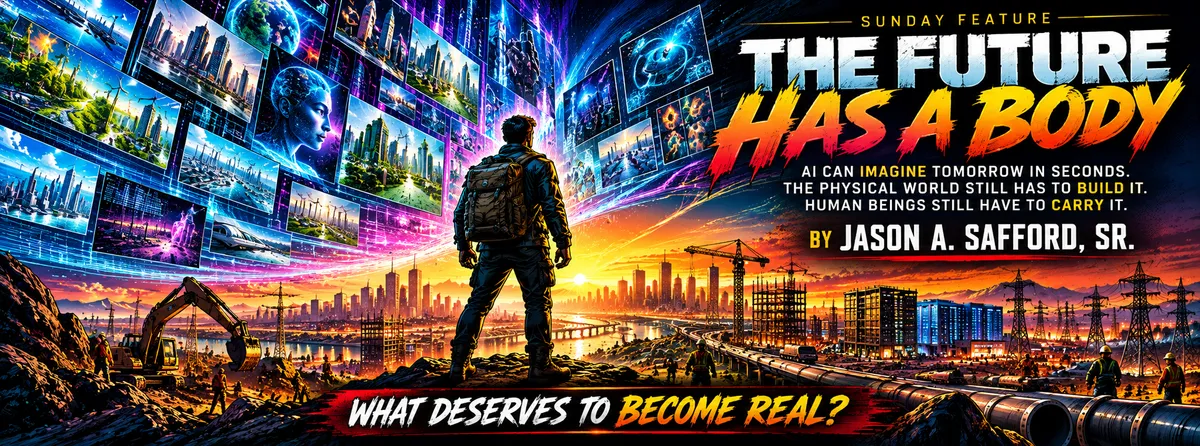
THE FUTURE HAS A BODY
AI can imagine tomorrow in seconds. The physical world still has to build it. Human beings still have to carry it.
By Jason A. Safford, Sr., The Resilience Architect
When almost anything becomes possible, who decides what deserves to become real?
AI is not moving too fast. It is revealing how differently the rest of the world moves.
The answer can arrive in seconds. The power may take years. The transformer may take four years. The transmission network may take more than a decade. The copper still has to come from somewhere beneath the ground. And the person responsible for making sense of it all still wakes up with only twenty-four hours.
That gap may define the next era of human progress.
We spent decades making technology faster, smarter, cheaper, and more powerful. We are succeeding beyond what most people imagined. But our ability to create possibility may now be growing faster than our ability to turn possibility into reality.
Execution capacity may become the defining constraint of the future.
McKinsey estimates that meeting global infrastructure requirements through 2040 will require about $106 trillion in cumulative investment. That includes roads, ports, bridges, power grids, data centers, charging stations, fiber networks, and other systems needed for economic and technological growth. The number is difficult to comprehend. Yet much of the future we already imagine depends upon building it.
Before the future becomes digital, much of it must become physical.
We often talk about AI as if the future lives inside a computer.
It does not.
Someone must build the data centers. Someone must generate and move the electricity. Someone must find the land, water, materials, workers, capital, and time.
The future has a body.
WHEN EVERYTHING BECOMES POSSIBLE
Imagine an executive named Maya.
She represents no single person or company. She represents leaders who will increasingly stand between extraordinary technological power and stubborn physical reality.
Thousands of employees, customers, suppliers, investors, and communities depend on decisions made by people like her. Her company has invested heavily in AI. Now everyone expects that investment to make the company faster.
At 6:17 one morning, Maya asks her AI system a question.
She wants the fastest path to double capacity while cutting costs and entering three new markets. A few years earlier, teams might have spent months studying the problem. Her first analysis arrives before she finishes her coffee.
Fourteen strategies appear.
Every one looks possible.
Maya asks the system to improve them. It produces more choices. She changes the capital assumptions. More choices appear. She adds energy costs, climate risk, labor, and suppliers.
The machine keeps answering.
By 6:32, Maya knows more than she knew fifteen minutes earlier.
She also has more decisions to make.
Every answer creates another possibility. Every possibility creates another dependency. Every dependency creates another place where execution can fail.
More intelligence has not made her problem smaller.
Then the operating team joins the call, and the frictionless future on Maya’s screen meets the world it must pass through.
One site is waiting for power. Another is running out of water. A supplier cannot move fast enough. The grid measures time in years, not seconds. Insurance grows more expensive. Six transformations already compete for the same finite pool of attention.
Maya turns toward the screen.
Fourteen futures glow back at her.
Each one possible.
Each one asking for something.
Power. Water. Capital. Time. Attention. People.
The AI offers fourteen more.
For a moment, Maya says nothing.
The machine has given her an abundance of answers and, in doing so, revealed the scarcity beneath them.
Ideas are not the limit.
Intelligence is not the limit.
Even possibility is not the limit.
What stands between imagination and reality is something no answer can make infinite.
Capacity.
WHEN MORE INTELLIGENCE CREATES MORE WORK
This is the paradox hiding inside the AI revolution.
We assume greater intelligence will reduce the burden on human beings. AI can eliminate tasks, accelerate analysis, automate workflows, and expand what one person can accomplish.
But every new capability also creates new possibilities.
Someone still has to decide which possibilities matter.
The Capacity Economy™ offers a framework for understanding the deeper organizational problem. Companies cannot simply acquire new capabilities and expect better results. They must integrate, govern, prioritize, coordinate, verify, and adapt them.
AI reduces the cost of producing information while potentially increasing the demand for judgment. The hidden cost of intelligence can therefore become organizational.
The bottleneck moves from producing answers toward choosing among them.
That shift reaches far beyond Maya.
The founder can launch more products. The investor can screen more companies. The employee can produce more work. The marketer can create more campaigns. The parent can access more advice than any parent in history.
More becomes possible.
Then more becomes expected.
A task that once required three days may take three minutes. We rarely give the other two days back to the person. We fill them with something else.
Soon yesterday's breakthrough becomes today's baseline.
Efficiency becomes expectation.
Expectation creates more work. More work consumes capacity. Poor priorities create unnecessary work. Fragmentation, duplication, rework, and weak coordination leak capacity.
The goal cannot simply be to make people endure more.
WE MAY KNOW MORE THAN WE CAN CARRY
Human cognition did not become exponential because our machines did.
We still have limits on attention, memory, judgment, emotion, and decision-making. The Capacity Economy describes the widening gap directly. Information generation can expand exponentially while human decision capacity expands gradually.
More information can create more options, more evaluation, more coordination, and more friction.
This creates a new scarcity.
Information becomes abundant while attention becomes scarce. Answers multiply while context becomes scarce. Communication accelerates while alignment becomes scarce. Intelligence expands while leadership bandwidth remains limited.
We may know more while feeling less able to control what happens next.
Most people do not need a research paper to understand that feeling.
Your inbox fills while you work. Your phone delivers opportunities, warnings, requests, and opinions all day. Your calendar can consume every open hour. Your family still needs you. Your body still needs sleep.
Now add AI.
It can help you write, research, analyze, plan, design, learn, invest, and communicate. It promises to give you back time. It also expands what everyone around you knows you can produce.
Soon the question changes from whether you can do something to how quickly you can do it.
Possibility becomes pressure.
NOW SCALE THAT FEELING TO THE WORLD
What Maya feels inside her company is happening outside it.
McKinsey estimates that meeting global infrastructure requirements through 2040 will require about $106 trillion in cumulative investment.
Infrastructure itself is also becoming more connected. Data centers need power. Power needs transmission. Digital systems depend on energy systems. Transportation increasingly depends on both.
What looks like one infrastructure problem quickly becomes several interconnected problems.
Money alone cannot solve that challenge.
Projects need materials, labor, land, equipment, permits, supply chains, and time. Each new system depends upon other systems. Every dependency adds complexity.
The physical world does not disappear because the digital world moves faster.
AI can help.
McKinsey describes infrastructure companies using AI to model project plans, test scenarios, improve scheduling, analyze sites, and improve construction sequencing. Those capabilities could help humanity build more efficiently. They could reduce waste and reveal solutions people might otherwise miss.
But a faster blueprint cannot make every physical constraint disappear.
Consider electricity.
More than 2,500 gigawatts of renewable projects, storage projects, and large electricity loads are waiting in grid connection queues around the world. Data centers can take roughly one to three years to develop. Major grid infrastructure can require five to fifteen years. The International Energy Agency estimates that annual grid investment needs to rise by roughly 50 percent by 2030 from today's level of about $400 billion.
The intelligence may arrive first, the building next, and the electricity last.
Now picture one advanced AI server rack.
The International Energy Agency estimates that by 2027 its peak electricity demand could equal that of about 65 households. Power density in AI servers increased roughly elevenfold between 2020 and 2025. The agency projects another fourfold increase by 2027.
Thousands of these machines can work silently inside buildings most people never see.
The cloud has a body.
That body needs materials.
Copper connects power systems, buildings, motors, electronics, factories, and much of the electrified economy. The IEA's 2026 critical-minerals outlook projects that expected copper supply could fall about 25 percent short of projected demand by 2035.
AI may help engineers use materials better. It may help discover alternatives.
It cannot command copper into existence.
The future must also negotiate with climate and water.
The World Meteorological Organization reports that 2015 through 2025 were the eleven warmest years in the observational record. The United Nations reported in 2026 that 2.1 billion people still lacked safely managed drinking water.
New infrastructure will enter that world rather than some frictionless digital version of it.
We are asking the physical world to carry more while parts of it already face enormous pressure.
THE MOST DANGEROUS ASSUMPTION
The most dangerous assumption of the AI age may be the one that feels most natural.
Imagination becomes a blueprint. A blueprint becomes something we expect to build. Construction creates a demand for power, power brings a price, and investment eventually becomes something people must operate, maintain, and sustain.
At every threshold, possibility asks more of the world carrying it.
Between every promise and every outcome stands capacity.
That capacity lives everywhere the future must pass: in physical systems, inside organizations, across communities, within people, and ultimately in the Earth itself.
None of these limits is fixed. Human progress has always pushed against them, finding better tools, stronger systems, new sources of energy, and wiser ways to use what we have. AI may help extend those boundaries again.
But progress begins by recognizing that a boundary exists.
Expanding what the world can carry is very different from pretending it can carry everything.
THE CAPACITY GAP
Every economic era develops around something scarce.
Industrial economies competed around production. Knowledge economies rewarded expertise. Information economies rewarded access. Digital economies increased the value of connectivity and speed.
The Capacity Economy™ proposes that AI is changing the nature of scarcity again.
Information becomes easier to produce. Intelligence becomes cheaper to access. Analysis becomes faster. Capability spreads.
But somebody still has to turn all that possibility into coordinated action.
As intelligence becomes abundant, adaptive capacity becomes more valuable.
The relationship can be expressed simply:
Sustainable Performance ≈
(Capability × Adaptive Capacity) ÷ Complexity
Capability gives us more things we can do.
Adaptive capacity determines how well we absorb change, choose priorities, coordinate action, preserve decision quality, and learn.
Complexity represents the growing demands surrounding those capabilities.
Performance therefore does not automatically rise when capability rises.
We must increase our capacity to absorb what capability creates.
Imagine capability doubling while complexity triples. If adaptive capacity stays the same, the organization does not necessarily become twice as effective.
It may simply become more difficult to lead.
More technology can create more overwhelm.
MAYA STOPS ASKING FOR MORE
Maya eventually sees the problem differently.
Ideas are everywhere. Data arrives faster than leaders can absorb it. Technology offers more capability than the organization can integrate without losing coherence.
Opportunity is no longer scarce.
The challenge is choosing what deserves to move forward.
It is governing abundance.
So Maya changes the question.
She stops asking AI what else the company can do. She begins asking what the organization can responsibly carry.
She measures available power, capital, talent, water, leadership attention, supplier capacity, and operational risk. She starts treating attention and decision bandwidth like scarce capital.
Then she cuts projects.
Some of them are good.
A few could become extraordinary.
But every yes consumes something.
Every commitment removes capacity from somewhere else.
Money.
Energy.
Attention.
Trust.
Time.
Human life.
CAPACITY IS NOT THE ABILITY TO DO MORE
Our traditional idea of resilience becomes insufficient here.
Resilience cannot simply mean enduring greater pressure. A person who absorbs endless pressure eventually breaks. An organization that accepts endless priorities eventually loses coherence. A civilization that treats physical resources as infinite eventually meets physical reality.
Resilience must include something harder than endurance.
It must include the capacity to choose.
Clarity begins with knowing what matters, then understanding what people and systems can truly carry.
Some possibilities will shine while hiding their costs. Others will demand more than they return. When every demand cannot be met, wisdom lies in recognizing what must be refused so that what matters most can endure.
Capacity reveals itself at the edge of possibility, where doing more gives way to choosing wisely.
Not every possibility deserves our resources. Not every opportunity deserves pursuit. Sometimes the harder act is refusing the seductive yes, preserving what matters for what matters more.
Perhaps our greatest capacity is knowing what deserves to become real.
2035
Move Maya's story forward ten years.
It is August 2035.
An extreme heat event has pushed electricity demand across the region. Her AI has already repriced energy, rerouted freight, modeled customer demand, assessed suppliers, and generated fourteen responses.
Her board meeting begins in eighteen minutes.
The grid operator cannot provide all the power her expansion requires. A delayed materials shipment threatens another facility. Water officials have imposed temporary restrictions. Customers on three continents expect commitments. Investors expect growth.
Fourteen optimized futures glow on Maya's screen.
None works for everyone.
Protect one facility and another slows.
Protect one market and another customer waits.
Accelerate expansion and workers carry more pressure.
Delay expansion and investors lose patience.
Give one demand more resources and something else receives less.
Maya asks the machine for the optimal answer.
It gives her one.
She studies the recommendation.
The mathematics may be right.
The tradeoffs remain hers.
Then she asks the question that changes everything.
Optimal for whom?
WHEN POSSIBILITY BECOMES RESPONSIBILITY
That may become one of the defining questions of the AI age.
Machines can calculate efficiency, model probability, price risk, and reveal paths human beings might never find.
Yet once every path carries consequences, optimization is no longer enough.
Power directed toward one facility may be unavailable to another. Growth can demand sacrifice from a community. Investors may have to reject the fastest path because its risks are too great. Behind every optimized answer are people who must live with what follows.
Intelligence can illuminate the choices without carrying the weight of choosing.
Judgment determines what matters.
Courage accepts the cost.
Restraint recognizes when possibility should remain possibility.
Together, they become capacity.
As AI expands what is possible, boundaries that once narrowed our choices begin to fall away. Thousands of paths emerge, bringing futures once beyond imagination within reach.
With abundance comes a different burden.
Finding the answer gives way to deciding which answer deserves action.
Attention becomes a choice.
Resources become a commitment.
Consequences become ours to carry.
Greater possibility creates greater responsibility.
At that threshold, the defining question changes.
No longer:
What can we do?
But:
What deserves to become real?
THE FUTURE WE ARE BUILDING
Artificial intelligence is loosening constraints that governed human possibility for centuries.
Discovery accelerates. Analysis that once consumed months can unfold in moments. Designs multiply. Ideas become possibilities almost as quickly as we can imagine them.
For perhaps the first time, the speed of our imagination is beginning to outrun the speed of the world required to make it real.
What remains finite now matters more.
Every imagined future asks something of the world: energy to power it, materials to give it form, water to sustain it, infrastructure to carry it, attention to understand it, and judgment to decide whether it should exist at all.
AI will not create the future for us. It will bring more futures within reach.
Some will change lives.
Others will consume more than they return.
Abundance will not free us from choosing. It will make choosing harder.
Resources remain finite. Sacrifice still carries a cost. Attention still runs out. Extraordinary ideas may deserve no. Imperfect ones may deserve yes.
Somewhere between everything we can create and everything the world can carry, one question remains:
What deserves to become real?
A machine can imagine tomorrow in seconds.
Tomorrow cannot arrive that way.
Before possibility becomes reality, it must pass through earth and water, grids and roads, organizations and communities, trust and time.
Eventually, it must pass through us.
Computation may race ahead, but physics will not. Concrete still needs time to cure. Copper still has to come from the ground. Trust must be earned. People need time to understand, adapt, recover, and choose again.
That distance between what intelligence can imagine and what life can sustain may become one of the defining tensions of our time.
Our task is not to make everything move at the speed of the machine.
It is to know what deserves pursuit, what should remain only possible, and what we are prepared to carry once possibility becomes consequence.
Because eventually, the future leaves the screen.
It becomes a power line across a landscape. A building rising from the ground. A resource consumed. A community changed. A human life altered by a decision someone once called a possibility.
The future must become physical.
Its consequences become human.
And someone must carry them.
Because the future has a body.
And so do we.