The Price of Believing: AI Startup Investment Judgment
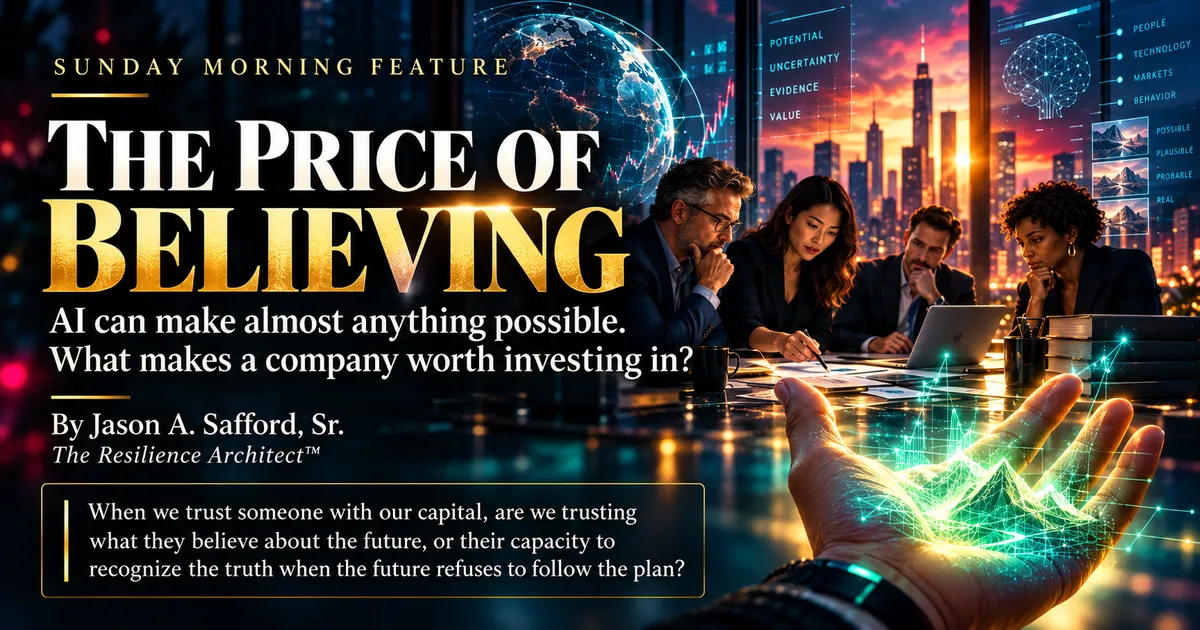
THE PRICE OF BELIEVING
AI can create value. What determines whether that value reaches investors?
Founders need capital before the proof is complete. Angels, venture funds, and their limited partners need to know what justifies a commitment, what should change it, and how success will reach them.
By Jason A. Safford, Sr. | The Resilience Architect
In April 2023, Imran Chaudhri raised his hand on a stage in Vancouver. Green letters appeared across his palm. His wife and business partner, Bethany Bongiorno, was calling. A small device on his jacket carried the call.
No phone filled his hand.
Chaudhri had spent more than twenty years at Apple, helping shape devices that changed how people lived. Now he wanted the screen to disappear. His company, Humane, was developing the Ai Pin, a wearable computer that promised answers, translations, and information without the constant reach for a phone. The TED demonstration offered something people could want: technology that gave them more of their attention back. TED
Humane reportedly raised about $240 million in venture capital. TechCrunch That money bought the company time to turn its promise into a product. Customers would decide whether the product deserved a place in their lives.
For an investor, those are different tests. You can be right about the technology and still be wrong about the investment.
The demonstration showed what the device could do. The harder test was whether people would choose it when their phones were still within reach.
The answer in the kitchen
By April 2024, the Ai Pin was in WIRED reviewer Julian Chokkattu’s hands. At his parents’ home, a temple appeared on the television. The device identified it as Angkor Wat in Cambodia. Chokkattu checked Google Lens on his phone. It was Phraya Nakhon Cave in Thailand.
The device meant to reduce his reliance on a phone had given him a reason to reach for one.
His review also reported overheating, slow responses, and poor daylight projection. The rating was four out of ten. WIRED
A founder can describe what another year of development might achieve. A customer has to use what arrives today. An investor may reasonably fund the distance between them. But the next dollar needs to buy something more specific than another year of hope.
In February 2025, HP announced a $116 million agreement to acquire key Humane assets. These included its Cosmos platform, technical talent, and more than 300 patents and patent applications. HP saw potential beyond the original consumer device. HP
Ai Pin owners faced a different outcome. Humane announced that the device’s cloud services would stop that month. Calling, messaging, and AI assistance would no longer work. Customers had bought hardware whose essential functions depended on a service that was ending. Yahoo Finance
The announced transaction price was below the venture capital reportedly raised. That comparison does not establish what each investor lost. Share classes, preferences, and transaction terms determine what owners receive.
Nor does the outcome tell us what every investor knew when a check was written. A failed product is not proof that the original risk was unreasonable.
The narrower lesson is enough. A buyer could see potential in Humane’s assets while customers lost the service they had purchased. Technical potential, a sustainable business, and an investor’s return were separate questions.
I had faced my own version of that distinction years earlier, with founders I wanted to help and money I had committed.
Where the work changes
Humane’s outcome could not settle the wider question. Away from the launch stage, researchers were measuring what happened when AI entered work people already had to do.
Erik Brynjolfsson, Danielle Li, and Lindsey Raymond studied an AI assistant used by 5,172 customer-support agents. Their research, published in The Quarterly Journal of Economics, found a 15 percent average increase in issues resolved per hour. Less experienced and lower-skilled workers gained the most. Experienced workers gained much less. The researchers also found evidence of faster learning and improved customer interactions. OUP Academic
These were measured changes in work, not promises about a future product.
In healthcare, Abridge sought to reduce the time physicians spent preparing notes. Mayo Clinic researchers examined 332 primary care physicians before and after adoption. Average time spent in notes fell from 5.11 to 4.16 minutes per note, an 18.6 percent reduction. The comparison could not rule out the influence of other changes. It did not establish better patient outcomes or an investment return. Mayo Clinic
Less than a minute can sound small. Across a day of appointments, it deserves attention. So does a support team resolving more problems in the same number of hours.
But the person whose work improves may not control the budget.
A physician may value the time saved while a hospital questions the software bill. A support agent may welcome an assistant while the buyer counts the time required to check its answers. A pilot may establish usefulness without establishing a price the customer will keep paying.
The founder has to connect those decisions. Who benefits? Who approves the purchase? What result earns renewal?
The investor has another task: follow the benefit into the supplier’s accounts. Software fees, implementation work, error correction, and ongoing support all belong in the calculation. Growth matters only in the context of what it costs to deliver.
A real improvement is the beginning of the case. The next question is who keeps its value.
The uncomfortable test
Klarna made that question harder to dismiss.
In 2024, the Swedish financial technology company reported that its AI assistant had handled millions of customer conversations and performed work equivalent to hundreds of agents. The implication was attractive: faster service at lower cost.
By May 2025, the account had become more complicated. Bloomberg reported that CEO Sebastian Siemiatkowski believed the emphasis on cutting service costs had compromised quality. Klarna was recruiting people and emphasizing customers’ ability to reach a human representative. Entrepreneur
That did not mean AI had disappeared from the operation. In its 2025 annual report, Klarna said the assistant handled 80 percent of customer-service chats without a decline in consumer satisfaction. Those were company-reported measures, not an independent evaluation. SEC
The two accounts need not cancel each other out. Automation can handle routine work while people deal with problems that require judgment, care, or a longer conversation. A company can revise its approach without abandoning the technology.
For an investor, the correction may be more informative than the original announcement.
What changed after management encountered the limits? Did the company improve the service, or merely change how it described the service? Did the economics still work once the cost of human support was included?
Those questions resist the easy verdict. “AI worked” says too little. So does “AI failed.”
The investment case concerns the whole operation. A cheaper first response has less value if it produces another call. A system that preserves human support may cost more than the original forecast and still be worth buying.
The supplier faces a further test. Its customer may capture most of the savings. Competitors may force prices down. Model providers may charge for the infrastructure underneath the product.
The work can improve while the investment disappoints.
Capital is abundant. Liquidity is concentrated.
Through September 2026, U.S. venture deal value reached $515.8 billion, according to the PitchBook-NVCA Venture Monitor. AI companies accounted for 82.7 percent of that total. PitchBook
Fundraising showed its own concentration. U.S. venture funds raised $108.5 billion through the third quarter. Funds of at least $500 million captured 78.1 percent of those commitments. Eighteen U.S. venture-backed companies went public in the third quarter. NVCA
The problem was not a complete absence of exits. A small number of large transactions drove record headline exit value. That was different from a broad recovery in liquidity. PitchBook
Money entering the system and money returning to its investors are not the same movement.
An LP cannot spend a private valuation on a pension payment or a scholarship. A manager must eventually turn ownership into proceeds. Raising the next fund does not complete that obligation to the last one.
In June 2024, Sequoia investor David Cahn revisited the spending behind AI infrastructure and the revenue needed to support it. His question was plain: “Where is all the revenue?” His estimates depended on assumptions, but the question reached beyond those estimates. Sequoia Capital
A technology can transform commerce without enriching every company built around it. Customers may capture the savings. A few platforms may capture the profits. An investor may correctly anticipate the transformation and own too little of the businesses that benefit.
Speed creates a related problem. If AI lets a team build its first product faster, the investor should ask what happens when competitors gain the same advantage. What remains after a feature is copied, a price falls, or a supplier changes its terms?
Access to a celebrated financing round does not answer those questions.
For a venture manager, the opportunity must also fit the fund. The entry price, required ownership, and capital needed for later rounds belong in the same decision. A company can be worth backing and still be the wrong investment for a particular vehicle.
That distinction is easier to state before money and reputation are committed.
I had learned how difficult it could become afterward.
A lesson I helped pay for
Years before this AI boom, a business colleague introduced me to three young founders. They were building a communication keyboard around emojis. They had committed time and what little money they could gather. My colleague asked me to assess the business and consider getting involved.
I believed the project deserved a chance. I added my time and money.
The founders hired a technical team. Deadlines slipped. The agreements offered too little protection when delivery fell behind. Spending left less room to recover. The product never reached a viable first version, so the founders could not establish customer demand.
The idea remained appealing while the evidence supporting the plan weakened.
Eventually, one founder bought out the other two. I continued working with him for another year.
More capital did not arrive. We did not get the product into a form customers could use. The effort consumed resources and changed a relationship I valued.
I cannot speak for every participant’s judgment. I can account for mine.
I had given too much weight to commitment and potential. We needed clearer rights to the code, stronger delivery milestones, and earlier customer evidence. Each missed deadline changed what the remaining money could reasonably accomplish. I did not always give that change enough weight.
My wish to help did not answer the investment question.
At the start, I had asked whether the idea deserved an attempt. Later, I needed to ask whether the next commitment still made sense. The questions sounded similar because the people and the ambition were the same. The evidence was not.
I had not kept those decisions separate enough.
It would be convenient to make this a story about what the founders should have done. That would leave out the part I controlled. I had chosen to participate. I had continued to help. My judgment belonged in the review.
I could not ask the founders for accountability while keeping my own judgment outside it.
Today, I would establish what the team must deliver and who controls the work. I would specify the customer evidence needed for the next stage. Before enthusiasm made the conversation harder, I would identify what could cause us to stop, change direction, or withhold another commitment.
Then I would return to those terms when the facts changed.
That would not make every missed target a reason to quit. Another investment might buy a necessary repair or resolve an uncertainty that still justified the cost. But the next test would need to be clear: what remained unknown, what we would spend to learn it, and what result would govern the decision after that.
This is a rule I draw from the experience, not one I claim to have followed perfectly.
The money already spent could not, by itself, justify money still to come.
A new commitment needs a new reason.
What would change the decision?
The question is not simply whether a founder can explain a setback. It is what changes after the explanation.
My work with leaders led me to develop Resilience Architecture™ around three disciplines. Corrective Development™ identifies what limits performance. Strength Development™ builds on what already works. Performance Conditioning™ asks whether those strengths hold under pressure. Its application to investing remains a proposal to test, not a proven way to predict returns.
The proposed use is practical. Identify a material constraint. Record when it became clear, what management did, and what happened next. Then determine whether the correction lasted and how the evidence affected the capital decision.
An explanation of failure is not evidence of correction. A correction is not yet evidence of durable improvement.
Consider a hypothetical startup selling AI tools to customer-service teams. Its founders claim each agent saves thirty minutes a day. Trials look promising. Several companies express interest.
An investor examines the records. Agents answer the first question faster, but spend much of the saved time checking errors. Some customers call back more often.
The original claim no longer describes the full result.
Management could defend the number and promise a better version. Or it could measure checking time, narrow the product to tasks it handles reliably, and repeat the trials.
The investor would then look for results: lower correction costs, customers willing to renew, and margins that hold after the necessary support is included. A further commitment might be justified by a well-defined test. A persuasive explanation alone would not be enough.
An experienced investor could reasonably ask whether this is conventional diligence under another name.
That challenge belongs in the discussion. Financial, commercial, and technical diligence remain essential. The proposed application would earn a place only if it added useful evidence about how management detects problems, responds, and prevents them from recurring.
Its value would have to appear in the records and decisions, not in the terminology.
Even then, an adaptable team could build a poor investment. Its market could be too small. Its advantage could be temporary. Its share price could assume more success than the business was likely to achieve.
Resilience cannot repeal investment arithmetic.
What reaches the investor?
Consider a hypothetical angel who invests $100,000 for one percent of a startup at a $10 million post-money valuation.
Later rounds reduce the stake to half a percent. Years pass. The company sells for $20 million.
Assume simple pro-rata proceeds, with no preferences or other adjustments. The angel receives $100,000.
The company has reached an exit. The investor has recovered the nominal amount originally invested, before costs and the effect of inflation.
Nothing in the arithmetic disputes the work required to build and sell the company. It shows why the company’s achievement and the investor’s outcome require separate attention.
The entry price mattered. So did the ownership retained.
For a fund manager, the decision extends to reserves. Capital committed to later rounds may defend ownership in a strong company, but it cannot also fund a new investment. The manager must decide which opportunity deserves it.
Fund size changes the significance of the result. A tenfold return on a position may materially affect a small fund and barely move a much larger one. Startup quality does not settle portfolio construction.
The investor therefore has to follow the entire path. Whose work improves? Who pays, and why will payment continue? Can the company deliver the benefit repeatedly while retaining enough value? Can management correct what fails? What can the investor reasonably earn at the offered price and ownership?
The final question can change the answer to the others.
For LPs, the inquiry reaches the manager. Why buy at that price? What evidence governed the next check? How were dilution, losses, and returned capital reported? Did the manager distinguish an improving company from an attractive additional investment?
Those questions put the allocator under the same scrutiny as the founder.
A compelling philosophy is not a performance record. A manager has to show the decisions made, the information available at the time, and the results that followed. Even a strong record cannot guarantee the next fund.
But it gives the LP something more substantial than access, confidence, or a favorable mark.
It shows what the manager did when belief became expensive.
The green light
In the recording from Vancouver, Chaudhri still raises his hand. Bethany’s call glows across his palm. The scene retains its wonder. TED
I think about that image alongside the founders I once tried to help. The circumstances were different. My responsibility was specific: judge the next commitment by what we now knew, not only by what we had hoped.
Founders need investors willing to act before proof is complete. Waiting until every uncertainty disappears would mean refusing many of the opportunities venture capital exists to pursue.
But uncertainty is not a reason to stop examining the decision.
A setback may justify more capital. It may call for a narrower plan. It may reveal that the remaining opportunity no longer warrants the cost. The obligation is to make that judgment without asking the previous commitment to defend the next one.
The first check expresses a belief. Every decision after it tests that belief against the world.
The light on Chaudhri’s hand showed what an idea could do. It could not show what the idea was worth.