The Weight We Learn to Carry: How Failure Builds Capacity
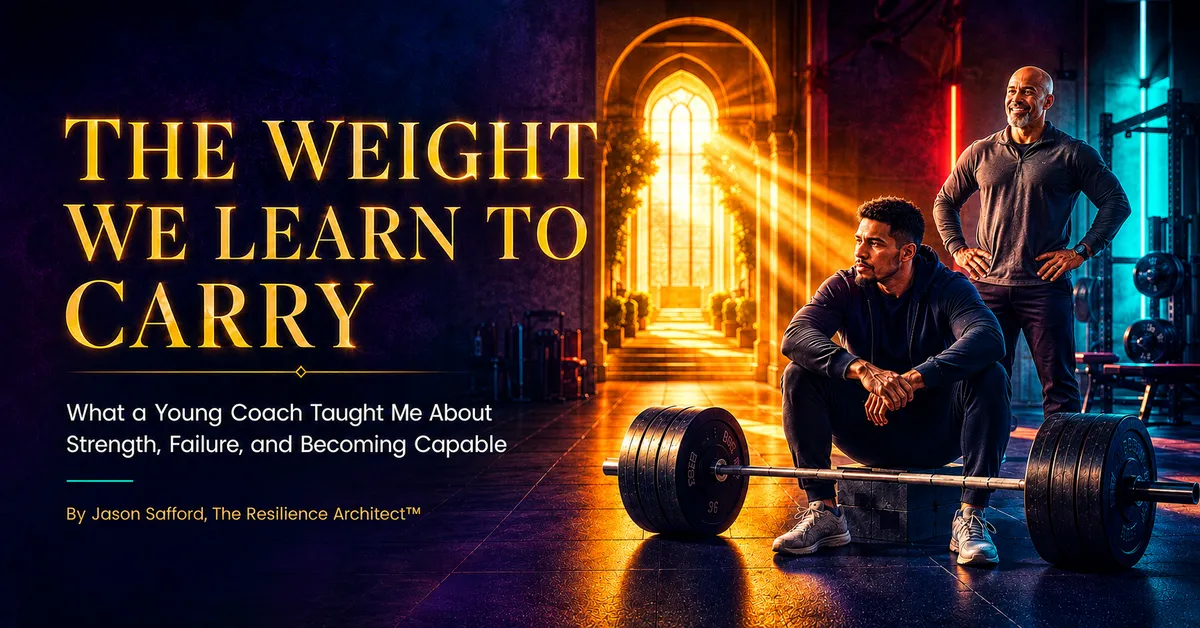
The Weight We Learn to Carry
What a Young Coach Taught Me About Strength, Failure, and Becoming Capable
By Jason A. Safford, Sr., The Resilience Architect
“You’re coming Sunday, right, Pops?”
Simon asked as if the answer should have been obvious. Perhaps it was. We had traveled too far together for me to miss the moment when he stepped into the life we once struggled to imagine.
“Yes,” I said. “I RSVP’d.”
“Okay. My girl gets the responses, not me.”
“Your wife,” I reminded him.
There was a pause.
“Oh, yeah,” he said, laughing. “I gotta get used to saying that.”
“Better start now. Sunday will be here before you know it.”
“I know, Pops.”
His voice softened. For a moment, neither of us spoke. I could almost hear the distance between the young man I had first met and the man waiting on the other end of the phone.
“You ready?” I asked.
“For the wedding?”
“For all of it. Marriage. Texas. Starting over.”
He took a breath.
“I’m nervous.”
“Good.”
“Good?”
“It means you understand that this matters.”
His laughter carried more tension than joy.
“What if I mess it up?”
“You will.”
“That’s supposed to make me feel better?”
“You will make mistakes, Simon. So will she. Marriage is not about avoiding every mistake. It is about deciding what you will do after one.”
“That sounds like one of your lessons.”
“Maybe you finally started listening.”
“I always listened, Pops.”
His answer reached deeper than either of us expected. There had been years of lessons between us, but most had not looked like lessons at the time. They sounded like arguments in a gym, corrections after lost sales, and hard conversations about money, food, fear, discipline, and responsibility.
For years, I believed I was helping Simon become a better coach, salesman, businessman, and man. I did not realize Simon was teaching me what transformation requires. His struggles forced me beyond motivation toward a harder question: How does a person develop the capacity to make better decisions when life keeps changing?
“I’m proud of you,” I told him.
“You don’t say that often.”
“I say it when it has been earned.”
“So I earned it?”
“You’re still asking me?”
He laughed.
“No,” he said. “I know I did.”
There it was. The young man I met in Forest Hills would have needed me to convince him. The man preparing to marry the woman he loved could recognize the evidence for himself. He was no longer borrowing my certainty. He had begun carrying his own.
The Young Man at Forest Hills
We met at New York Sports Clubs in Forest Hills. Simon was twenty-four, energetic, talkative, and eager to prove himself. I was approaching fifty and deciding what my next chapter should become. Our age difference was obvious. The questions we carried were not.
I had come from UFC Gym, where the commute was long and the demands had begun taking more than the work returned. I was considering whether to buy a gym, open one, or create a different kind of fitness business. Every option had to survive one test. My family had to remain first in my time and attention.
Simon knew none of that when he began drifting toward me between appointments.
“Coach, what do you think about this program?”
“Coach, how would you handle this client?”
“Coach, can I ask you something?”
At first, I assumed he wanted help. Fitness coaches often learn by watching someone with more experience. Simon watched more closely than most. He studied how I spoke, handled pressure, and remained calm when the gym around us became loud.
Months later, he explained why.
“You look like my father,” he told me. “But it’s more than that. You seemed certain. When you say something, I believe it.”
I did not know how to answer him. I had never entered that gym intending to become a father figure to another man. Yet Simon had recognized something he needed before either of us knew how to name it.
Certainty can feel like shelter to someone who has lived without enough of it.
I began noticing how often he appeared beside me after a difficult interaction. Sometimes he had a question ready. Sometimes he only watched while I finished a session or spoke with a member. He was not copying technique alone. He was studying what steadiness looked like under pressure, hoping repetition might help him build it inside himself.
Beneath the Question
Simon’s questions appeared to be about training. Beneath them sat questions about identity. He wanted to know what exercise to prescribe, but also whether he could become someone worth following. He asked how to speak with prospects, but the deeper question was whether they would believe him.
“Why should they listen to me?” he asked after one difficult day.
“Do you listen to yourself?”
He laughed, but only for a moment.
“That’s different.”
“No, Simon. That is where it starts.”
The fitness industry had taught him how to count repetitions, design programs, explain muscle growth, and sell memberships. It had not taught him how to carry doubt. No certification could decide what he should do when money was short, clients said no, or his reflection challenged what he claimed to represent.
The same gap affected his clients. Most knew movement was good and food mattered. Their choices were shaped by stress, fatigue, shame, money, relationships, work, and years of evidence that they could not trust themselves. A perfect program could not survive inside a life with no room to carry it.
The industry often confused compliance with transformation. A client who followed the plan while a coach watched appeared successful. The real test came when the coach was absent, the week became difficult, and the person had to choose without applause or instruction.
People arrived carrying needs that did not fit neatly on an intake form. They wanted enough energy to play with their children, enough confidence to enter a room without shrinking, or enough hope to believe their future could still change. The industry measured weight, body fat, calories, and memberships because visible results were easier to market. A coach might celebrate ten pounds lost without asking what the person could now carry. A gym could sell access without creating belonging.
Simon stood on both sides of that contradiction. He wanted clients to trust him, yet he did not trust himself. He could construct a training plan but struggled to carry rejection, financial pressure, or the fear that he did not look like the coach he claimed to be.
“What do people really want from me?” he asked.
“They want to believe change is possible.”
“So I have to convince them?”
“No. Help them see themselves clearly enough to choose.”
Simon’s problem was not a lack of information. It was a lack of trust in his ability to choose. The body might bring a person through the door, but the deeper work was helping that person reclaim authority over his life.
Building Win Your Day Now
Simon became part of the encouragement I needed to leave NYSC. I had spent months studying the operation, the market, and the cost of building something of my own. The answer arrived through a series of conversations.
“You should do this yourself,” Simon told me.
“Do what?”
“Coach people your way. Build your own thing.”
Starting Win Your Day Now required me to leave the safety of an established gym without knowing whether the new business would succeed. Simon joined me as a Performance Coach. I became his partner, teacher, advisor, older friend, and sometimes the parent neither of us had planned for me to become.
The business gave both of us a place to test what we claimed to believe. I had to turn years of experience into something people could understand and trust. Simon had to learn that helping someone change required more than knowing the right exercise. Every prospect, client, setback, and unpaid bill placed another kind of weight on the ideas we were building.
Over the next two years, we discussed sales, money, food, relationships, discipline, and the gap between his intentions and actions. Some conversations were difficult.
The line between business and life rarely stayed clean. A weak sales week followed him home. A poor meal affected his energy with clients. Fear about money changed how he spoke to prospects. Each problem appeared separate until we began tracing the decisions connecting them.
“You keep telling me what you want,” I said during one of them. “What are you willing to do every day?”
“I’m trying, Coach.”
“Trying is not doing. Effort is not completion.”
Neither of us knew our small conversations were becoming experiments in human change.
The Ferrari Close
Business exposed what training had allowed Simon to hide. He knew how to help someone exercise but struggled to ask that person to pay for his help. A prospect’s hesitation felt like rejection, and one uncertain answer could follow him all day.
“I don’t want to pressure people,” he said.
“Then don’t pressure them.”
“How am I supposed to close?”
“Help them see what they are deciding.”
I built a sales program around the way Simon learned. We called it Simon’s Ferrari Close. Its image was simple: the human body is a high-performance vehicle, yet many people treat it like an old jalopy and wonder why it stops carrying them where they want to go.
“You wouldn’t put garbage into a Ferrari,” Simon told one prospect.
“No.”
“You wouldn’t ignore every warning light.”
“Of course not.”
“Then why are you treating your body that way?”
The question allowed the person to recognize the contradiction without feeling attacked. Simon’s results improved because he no longer believed his job was to convince people. His task was to help them see what their decisions were producing.
The customer often reached the conclusion before Simon asked for a commitment. The metaphor worked because it began with value rather than failure. It invited people to treat their bodies as worthy of attention before asking them to change their behavior.
But the words did not stop working when the conversation ended.
One afternoon, after hearing him deliver the close again, I looked at him.
“You believe that?”
“Believe what?”
“That the body is a Ferrari.”
“Of course. That’s why it works.”
“For everybody?”
“Yeah.”
“Including you?”
His expression changed.
“Coach, that’s different.”
“How?”
“I have diabetes. My body doesn’t work like everybody else’s.”
“That doesn’t make it less valuable.”
“I didn’t say it did.”
“You treat it like you believe it does.”
He looked away. Simon could tell another person that the body was a high-performance vehicle, then eat without precision, ignore his energy, and speak about his health as if the outcome had already been decided.
For most of his life, diabetes had felt like proof that his body was defective. Food carried risk. Numbers carried judgment. He had learned to manage the condition, but not to value the body carrying it.
Every fluctuation seemed to confirm that something inside him was wrong and might always remain wrong. He could explain nutrition to a client while treating his own choices as exceptions. The condition had become more than a medical reality. It had become part of the story he told himself about what was possible.
“You sell people a belief you haven’t claimed for yourself,” I told him.
“That’s harsh.”
“Is it false?”
He did not answer.
I was not asking Simon to pretend diabetes did not exist. A Ferrari with a sensitive engine is not worthless. It requires better fuel, closer attention, and more precise decisions.
“What if your body isn’t the problem?” I asked.
“What else would it be?”
“What if no one taught you how to understand what it has been telling you?”
Simon began approaching his body with curiosity. He tracked what he ate, when he ate, and how much. He studied the effects on his blood sugar, energy, weight, strength, and body composition. Each choice became information.
He stopped hiding behind words such as better, healthier, and trying. Those words had allowed intention to stand in for evidence. A recorded meal could be studied. A drop in energy could be connected to what came before it. The numbers no longer existed only to judge him. They could teach him.
“What happened after that meal?” I asked.
“My energy dropped.”
“What did you learn?”
“I can’t keep eating like that and expect a different result.”
That answer mattered more than any instruction I could have given him. Simon was producing his own evidence and making decisions from it.
His habits became deliberate. His strength improved, and his body composition changed. Under appropriate medical monitoring, his A1C eventually fell below 5.6. The condition that had once controlled his identity no longer held the same authority over his future.
The more Simon told customers that their bodies were valuable, the more he believed the same about his own. Each disciplined meal, completed workout, and improved measurement became proof. His body was not an enemy to fear. It was a system he could understand, support, and increasingly command.
His sales improved because his message had become coherent with his life. He was no longer describing transformation from a script. He was becoming evidence that it was possible.
The body Simon had feared became the place where he learned to trust himself.
Becoming the Student of Simon
For years, I believed I was coaching Simon. I had more experience, built the programs, and asked the questions. Only later did I see that his questions were teaching me what coaching was meant to build.
“Why don’t you just tell me what to do?” he asked one afternoon.
“If you wanted to get stronger, would I lift the weight for you?”
“No.”
“Why not?”
“Because then you would get stronger.”
I waited.
“And I wouldn’t,” he said.
That became the frame for our work. Simon’s life was a human training program across five areas. His mind needed clarity. His emotions needed stability. His body needed strength and energy. His life needed meaning. His imagination needed room to picture what could come next.
No part trained alone. A clear mind inside an exhausted body could still fail. A strong body without meaning could move in the wrong direction. A person might want change while remaining unable to picture the life that change required.
“Where do we start?” he asked.
“Where would you start with a client?”
“I would assess him.”
“Why?”
“So I know what he can do without guessing.”
“Then assess yourself.”
Simon frowned. He was used to measuring body weight, movement, strength, and endurance. Some of his most important limits could not be measured with a scale.
“How do I assess my mind?”
“How do you assess a muscle?”
“I put it under load.”
“What happens to your thinking when life gets heavy?”
“It gets noisy. I think about everything that could go wrong.”
“What would a stronger mind do?”
He thought about it.
“Stay with the decision.”
“For how long?”
“Long enough to act.”
There was his first exercise. Hold one clear decision long enough to complete the next useful action.
His plan could be clear while fear pulled against it. More information would not correct that conflict. Like a muscle shaking beneath a load, his mind was showing us where its present capacity ended. The answer was not shame. It was training.
“What happens when a weight becomes easy?” I asked.
“You add weight.”
“Then why do you expect confidence before the first repetition?”
Simon looked down and smiled.
“I don’t.”
His emotions required another kind of training. Physical strain belonged in the gym. Rejection, shame, and doubt felt more personal.
“What would you do if a client felt pain during a lift?”
“Find out what kind.”
“Why?”
“Some pain warns you. Some discomfort comes from effort.”
“Can you tell the difference in yourself?”
“Not always.”
“Then what needs training?”
“My ability to stay with the feeling long enough to understand it.”
Emotional safety did not mean removing every hard feeling. Simon had to learn which signals called for rest, which called for adjustment, and which were simply the strain of growth. He could not learn the difference by escaping every uncomfortable repetition.
His body gave us the clearest model. Simon understood that strength required sound form, steady work, proper fuel, and recovery. Yet he expected change elsewhere without the same care.
“You would never give a new client your hardest program on the first day,” I said.
“He couldn’t handle it.”
“So why do you keep building days you cannot recover from?”
He paused.
“I think doing more means I’m working harder.”
“Does more always make a muscle stronger?”
“No. Too much can break it down.”
“What does too much do to a life?”
Simon had no quick answer.
He began to see sleep, food, movement, and medical care as parts of the same system. His body was not separate from his judgment. When his energy fell, his patience shortened. When his blood sugar shifted, clear choices became harder to hold.
Meaning became the fourth part of the program.
“What are you training for?” I asked.
“To be successful.”
“That is not an event.”
“To make money.”
“That is not enough.”
“To help people.”
“Why?”
Simon grew quiet.
“So they don’t feel as stuck as I did.”
That answer changed the weight of the work. His struggle had given him something worth returning to others. Meaning did not remove the load, but it gave him a reason to carry it.
Then came imagination.
“How do I believe in a life I’ve never had?” Simon asked.
“How does a strength coach build a program?”
“From the goal backward.”
“Then show me the life.”
Slowly, he described a man who cared for his health, led clients well, and earned enough to build a home. That man could sustain a relationship, accept responsibility, and recover when life went wrong. Simon was no longer trying only to escape his present. He was training toward a future he could see.
“What does that man do today?” I asked.
“You always bring it back to today.”
“Where else can the repetition happen?”
He laughed.
Imagination provided the destination. Daily action supplied the repetitions. Evidence came through completed work. The future Simon described would not arrive through belief alone, but belief showed him what to practice.
“Coach, what do you think I should do?” Simon still asked.
“What does your assessment tell you?”
“If I knew, I wouldn’t be asking.”
“Do you know nothing, or do you dislike what you know?”
He looked at me.
“I probably know.”
“What is the load?”
“A decision I might get wrong.”
“Does every failed repetition mean the program failed?”
“No. It may mean the weight was too heavy, the form was wrong, or I need more recovery.”
“Then what might a poor result teach you?”
“What to change.”
Simon had begun answering his own questions. My role was changing with him. I was no longer there to remove every difficult weight. I had to help him choose one he could carry, watch his form, and let the result teach him what came next.
Borrowed confidence had helped him begin. It was like a spotter’s hands near the bar. The spotter creates enough safety for the lifter to attempt the repetition, but he must not steal the work.
“How do you know when to help me?” Simon asked.
“How would you know when to help a lifter?”
“If the weight is about to hurt him.”
“And when would you leave your hands off?”
“When he is struggling but still in control.”
“Why?”
“Because the struggle is the exercise.”
The answer stopped me. Simon had returned the lesson in the language I had given him.
For years, care had tempted me to step in too early. I could mistake being needed for being useful. If the bar rose only because the spotter pulled it, no strength had been built.
His problems did not disappear. Money, health, work, and relationships often placed demands on him at the same time. The difference appeared in how he met them.
One day, he brought me a decision that had cost him time, money, and trust.
“What will you do?”
“Own it. Repair what I can. Slow down before the next choice.”
“What do you need from me?”
“Nothing yet. I needed to hear myself say it.”
Simon was no longer handing me the weight. He was asking me to watch his form.
Now, as marriage and Texas waited before him, I asked whether he felt ready.
“Ready for what?”
“All of it.”
He smiled.
“You taught me there is no one program for all of it, Pops.”
“Then what will you do?”
“Assess what life is asking. Check all five areas. Choose a load I can carry. Do the work. Recover. Learn. Add weight when I’m ready.”
“And if you fail?”
“I study the repetition.”
“If you lose confidence?”
“I look at the evidence I already built.”
Simon watched me for a moment.
“You know that applies to you too.”
“To me?”
“You’re always trying to carry the whole thing. The business. The mission. Everybody who comes to you.”
“That is different.”
His smile widened.
“How?”
The question landed with the quiet force of a bar settling onto its rack. I had used it on him for years. Now Simon held the mirror.
“What would you tell me to do?” I asked.
He shook his head.
“I’m not giving you the answer, Pops.”
I laughed.
“Then what are you giving me?”
“A question.”
He leaned forward.
“What are you training for, and is the weight you’re carrying making you stronger or only making you tired?”
The room became still.
For years, I thought I was teaching Simon to carry more. He taught me that capacity was not built by carrying everything. It grew by meeting the right load with clarity, control, strength, meaning, and imagination.
The student had learned to coach himself. Then he returned the lesson to me.
The Wedding
On Sunday evening, music will fill a room while Simon and his bride make promises no plan can fully protect. Marriage will test their patience, judgment, habits, and ability to change together. Love will begin the commitment, but capacity will help them carry it.
I will sit among the guests knowing that transformation seldom announces itself while it is happening. It forms through meals recorded, calls reviewed, promises kept, and uncomfortable truths faced without escape. A wedding reveals the change. It does not create it.
I will watch Simon walk toward a future he once struggled to imagine. For a moment, I will see the young coach from Forest Hills. Then he will turn toward his bride.
That turn will matter.
Strength is not built by avoiding failure. It grows near the edge of present capacity, where another repetition is no longer certain. The purpose is not collapse. It is to create enough safety and awareness that failure becomes information rather than identity.
The strongest training programs do not promise that every repetition will succeed. They prepare the body to approach failure without panic and the coach to protect the athlete without stealing the effort. Failure reveals the current boundary. Safe practice allows that boundary to move.
Simon learned that a decision may fail without making the person who chose it a failure. A missed repetition reveals what the weight, form, preparation, or recovery demands next. When the mind feels safe enough to risk an imperfect result, it can learn instead of retreat.
That became the deeper purpose of Human Decision Architecture. It builds the clarity, emotional safety, physical capacity, meaning, and imagination required to choose without abandoning yourself when the result is uncertain.
Human Decision is not the search for choices guaranteed to work. No such choices exist. It is the development of a mind safe enough to choose, observe, and adjust. Each completed cycle becomes evidence that the next uncertain choice can be carried too.
For years, I believed I was helping Simon become a better coach. Our conversations became the hidden workshop where ideas about awareness, completion, adaptive capacity, and coherent decisions began to take form. His questions challenged my answers. His becoming helped me become the Resilience Architect.
His transformation gave me something more personal. As Simon imagined the man he could become, I remembered the man I had once imagined becoming. My highest vision was not a master surrounded by people who needed him. It was a man whose presence helped others carry their own lives.
Simon will leave New York after the wedding and begin again in Texas. Life will keep placing weight before him. He knows how to approach the edge, fail without fear, learn without shame, and return with greater capacity.
When he turns toward his bride, I will understand that he is not walking away from what we built. He is carrying it forward. The young man who once borrowed my certainty is ready to build a family with certainty of his own.
And in watching him become the man he once could not imagine, I will remember the ultimate vision I had for myself: to help another person walk into an unknown life and say, with quiet confidence,
I may not know what comes next.
But I am ready to carry it.